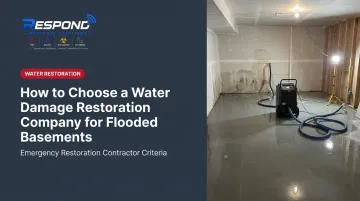
The difficulty is that most people choose a restoration company the same way they choose a plumber at midnight: whoever calls back first. That instinct is understandable, but it misses the factors that actually determine outcomes. Not all restoration companies carry proper certifications. Many lack basement-specific experience. Some produce documentation that falls short of what insurance adjusters need to approve a full claim.
This guide gives homeowners and property managers a practical framework for choosing the right flooded basement restoration company before panic overrides judgment.
Key Takeaways
- IICRC certification is the baseline standard — confirm it applies to the technicians arriving on-site, not just the company's name on paper
- Mold risk begins within 24–48 hours; response time is a material factor in final damage cost
- Basements require experience with Category 2 and 3 contamination, not just clean-water extraction
- Full-scope service from extraction through reconstruction prevents accountability gaps between contractors
- Strong insurance documentation (moisture logs, photos, Xactimate-compatible scopes) directly affects what your claim pays out
What Flooded Basement Restoration Actually Involves
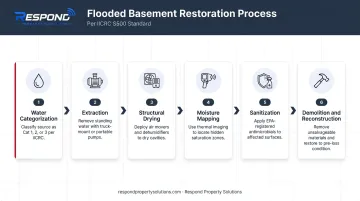
Most homeowners picture a crew arriving with wet-vacs and fans. In practice, flooded basement restoration follows the IICRC S500 standard — the industry's governing framework for professional water damage restoration. Under that standard, the process includes:
- Water categorization — classifying whether the water source is clean (Category 1), contaminated gray water (Category 2), or sewage/grossly contaminated (Category 3)
- Extraction — removing standing water with industrial equipment
- Structural drying — deploying air movers and dehumidifiers to dry embedded moisture
- Moisture mapping — using meters and thermal imaging to locate hidden moisture behind walls, under slabs, and inside cavities
- Sanitization — applying antimicrobial treatments appropriate to the water category
- Demolition and reconstruction — removing and replacing drywall, insulation, or flooring that cannot be dried in place
The EPA notes that materials should reach 15% moisture content or less before refinishing — and that drying can take several days to weeks depending on damage scope. Basements add another layer of complexity because the physical conditions underground work against that drying process at every stage.
Why Basements Are Higher Risk
Basements create specific complications that above-grade rooms do not:
- Limited ventilation traps moisture and accelerates mold growth in enclosed wall cavities
- Hydrostatic pressure from soil can push water back through foundation walls if the source isn't addressed — FEMA's flood-retrofit guidance specifically addresses this force on below-grade structures
- Contaminated water is more common in basements — groundwater intrusion and sewage backflow are far more frequent causes than a burst supply line
A company quoting only "extraction and drying" without addressing these factors is likely quoting an incomplete scope.
6 Factors to Evaluate When Choosing a Flooded Basement Restoration Company
The company that calls back fastest is not necessarily the one that will dry your basement correctly. These six factors separate verifiable competence from confident-sounding sales calls.
Certifications and Licensing
IICRC certification is the baseline filter. The IICRC S500 standard governs water damage restoration procedures for residential and commercial buildings, while IICRC S520 covers professional mold remediation. Certified technicians follow documented protocols rather than improvising.
The specific credentials to ask about:
| Credential | What It Covers |
|---|---|
| WRT — Water Damage Restoration Technician | Moisture measurement, drying science, water damage protocols |
| ASD — Applied Structural Drying Technician | Effective, efficient drying of water-damaged structures |
| AMRT — Applied Microbial Remediation Technician | Mold and sewage remediation techniques |
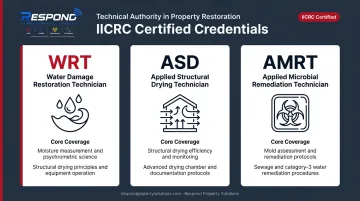
Ask whether on-site technicians — not just the company as a whole — hold current individual IICRC credentials. Company-level certification does not automatically mean every crew member dispatched to your property is personally certified.
Also verify state licensing. California's CSLB licenses and regulates construction contractors, and California employers are required to carry workers' compensation. Arizona's ROC performs the same function. An unlicensed crew that damages structural elements or injures a worker on your property leaves you exposed to liability.
Response Time and Local Availability
Every additional hour of standing water increases damage scope. The EPA and FEMA establish the 24–48 hour mold window as the primary urgency benchmark — and that clock starts when water enters the structure, not when the crew arrives.
Ask any company these two specific questions:
- Do you offer 24/7/365 emergency dispatch with live answering?
- What is your guaranteed on-site arrival window from the time of my call?
Vague answers ("we'll get someone out as soon as possible") are a reliable signal of a company routing calls through a national call center that dispatches subcontractors. A local company with its own crews can give you a specific window and actually honor it.
Basement-Specific Experience
Basement flooding frequently involves Category 2 or Category 3 water — contaminated gray water from groundwater intrusion, or sewage backflow from overwhelmed municipal systems. The IICRC's own position statement on weather-related events states that Category 2 or 3 intrusions require remediation before restorative drying and contamination controls throughout.
A crew without specific experience in contaminated water events can misclassify the water source, skip required containment steps, and leave biological hazards behind a newly dried wall.
Before hiring, confirm two things:
- Water classification protocol — Can the crew explain how they identify Category 2 vs. Category 3 sources and what changes in their process as a result?
- **Thermal imaging and moisture mapping** — Basements trap moisture behind block walls, beneath slab flooring, and inside post framing. Incomplete drying, not poor initial extraction, is the leading cause of secondary mold problems weeks after a job closes.
Comprehensive Service Scope
A company that handles only extraction and drying hands the homeowner a partially restored basement and a list of other vendors to call. That fragmentation has direct consequences:
- Accountability gaps when mold appears after the drying crew has left
- Scheduling delays between phases that extend the timeline
- Documentation inconsistencies that complicate insurance claims
Look for a company that can take a flooded basement job from initial extraction through reconstruction under one point of contact. Mold remediation capability is particularly important — if a company cannot perform or coordinate remediation to IICRC S520 standards, any moisture missed during drying becomes the homeowner's problem to solve separately.
Insurance Documentation and Claims Support
According to Verisk, Xactimate is the property claims estimating software that insurance carriers and adjusters use to evaluate restoration scopes. A company that produces Xactimate-compatible estimates, moisture logs, and photo documentation gives adjusters exactly what they need to approve a full payout. A company that hands over a verbal summary and a single page of photos leaves the homeowner fighting for coverage.
The California Department of Insurance specifically recommends written bids from licensed contractors with line-by-line pricing and material details. Documentation that doesn't meet that standard puts the claim at risk.
Find out whether the company communicates directly with your adjuster or whether you're expected to manage that relationship yourself. During an active restoration job, that handoff can cost you days and dollars.
Reputation and Verified Reviews
BrightLocal's 2026 consumer research found that 97% of consumers read local business reviews before making a decision. The challenge is reading them well.
Go beyond star ratings and look for:
- Mentions of basement flooding specifically (not just general water damage)
- Comments about response speed and crew arrival time
- References to how insurance claims were handled
- Patterns in complaints — incomplete drying, unreturned calls, and billing disputes are meaningful red flags regardless of overall rating
Ask the company directly for two or three references from clients with similar basement flooding jobs. Reluctance to provide references is a specific warning sign.
Questions to Ask Before You Hire
The first phone call is itself a screening tool. How quickly they answer, whether they ask about the job before quoting a number, and how specific their answers are — all of it signals how the actual project will be managed.
Key questions to ask any restoration company:
- Are your on-site technicians individually IICRC-certified?
- What is your guaranteed on-site arrival time from my call?
- Do you handle the full scope from extraction through reconstruction?
- How do you document damage for insurance, and do you communicate directly with adjusters?
- Can you provide references from past basement flooding jobs?
The Single Point of Contact Test
Ask whether one project manager owns the job from first call to final walkthrough, or whether you get handed off between an estimator, a crew lead, and a separate rebuild team. Fragmented ownership is one of the most consistent sources of unresolved damage and miscommunication on restoration jobs.
Written Estimates
Any company worth hiring will provide a detailed written estimate before work begins — covering full scope, equipment, expected timeline, and how mid-job discoveries are handled. Any company unwilling to commit this to writing upfront should be treated with caution.
How Respond Property Solutions Can Help
Respond Property Solutions has operated as an emergency restoration contractor across Southern California and Arizona since 1991, under the QRV Network quality standard — a protocol the company established in 1991 that regional insurers now include in their service level agreements. IICRC-certified crews, five branch locations (El Centro, Yuma, Redlands, Palm Springs, and Riverside), and 24/7/365 dispatch mean the company meets every core criterion this guide covers.
The process is direct: no third-party call centers, no warm-transfer queues. When you call 866.867.3123, you reach Respond directly. A live dispatcher confirms a local crew within 45 minutes of your call, with an on-site arrival window of 2–4 hours. For a flooded basement where the mold clock is already running, that response speed is a material difference from companies that route calls through national dispatch systems.
One project manager owns each job from first call to final walkthrough. That single point of accountability covers:
- Water extraction and structural drying
- Mold remediation through Respond Environmental Solutions
- Reconstruction
- Xactimate-compatible scopes with photo documentation
- Direct adjuster communication so homeowners aren't managing that relationship mid-crisis
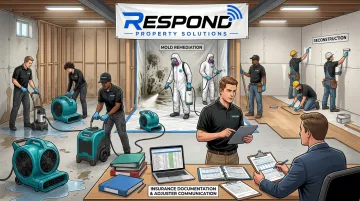
That end-to-end coverage extends across the full service footprint: homeowners, property managers, and commercial properties in San Diego, Imperial, Riverside, San Bernardino, Orange, La Paz, and Yuma counties. Readers in Southern California or Arizona can call 866.867.3123 to reach a live dispatcher and confirm availability for their specific location.
Conclusion
A flooded basement rarely gives you time to research. The six factors — certification, response speed, basement-specific experience, full-scope service, insurance documentation, and verified reputation — are what separate a job done correctly the first time from a property that develops mold or structural problems months later.
The practical action step: homeowners and property managers in Southern California and Arizona should save the number of a qualified, locally available restoration company before an emergency happens. Respond Property Solutions operates 24/7/365 across five branches in Southern California and Arizona — call 866.867.3123 before you need it. When a basement floods at 2 a.m., the first call should go to a company that answers live, dispatches fast, and owns the job all the way through.
Frequently Asked Questions
How much does it cost to restore a flooded basement?
Costs vary based on water category, square footage, structural damage extent, and whether mold remediation or reconstruction is needed. HomeAdvisor reports a typical range of $1,383–$6,378, with severe cases reaching $16,000 or more; Angi puts flooded basement cleanup at an average of $4,000.
How do I choose a water damage restoration company?
Prioritize IICRC certification, 24/7 local availability, documented experience with your specific type of damage, full-scope service from extraction to rebuild, and strong insurance documentation capability. Confirming these factors before an emergency means you're not making critical decisions under pressure.
Who should I call for a flooded basement?
Call an IICRC-certified water damage restoration company with proven basement flooding experience. Ensure personal safety first, then notify your insurance carrier. Avoid any company that cannot confirm same-day emergency response — delays increase both damage severity and mold risk.
How long does flooded basement restoration take?
Drying and mitigation alone typically takes several days to weeks — the EPA notes materials must reach 15% moisture content or less before refinishing, and that timeline cannot be safely compressed. Full reconstruction, if required, can extend the project further depending on damage scope.
Does homeowners insurance cover flooded basement restoration?
Coverage depends on the cause. Sudden internal events like burst pipes are typically covered under standard homeowners policies, while flooding from external groundwater generally requires separate flood insurance through the NFIP or a private policy.
Can I stay home during basement flood restoration?
It depends on the water category and damage extent. Category 1 (clean water) jobs with limited damage often allow homeowners to stay on-site. Category 2 or 3 jobs involving sewage contamination or active mold risk may require temporary relocation; the EPA notes that people with asthma, compromised immune systems, or children should avoid contaminated areas.