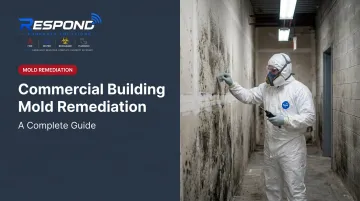
The stakes compound quickly: according to IRMI, the average commercial mold remediation costs $250,000 — and that figure assumes timely intervention. Add OSHA exposure, tenant complaints, and potential lease disputes, and the cost of delayed action becomes difficult to quantify.
This guide covers what commercial mold remediation actually involves, how it differs from surface cleaning, how the five-step process works, what drives mold in SoCal and Arizona properties, and what property managers need to know before, during, and after a remediation project.
Key Takeaways
- Wet commercial materials must be dried within 24–48 hours — mold colonies establish quickly once moisture sets in
- Commercial HVAC systems distribute spores building-wide; localized leaks become multi-zone problems
- Remediation without fixing the moisture source will always fail — the mold returns
- EPA-defined containment thresholds (10 sq ft, 100 sq ft) govern the required level of intervention
- Choose an IICRC S520-certified provider with Xactimate-compatible documentation and active insurance coordination
What Is Commercial Building Mold Remediation?
Commercial building mold remediation is the systematic process of identifying, containing, removing, and permanently controlling mold growth in non-residential structures — offices, schools, healthcare facilities, industrial sites, multi-family properties, and hospitality buildings. Understanding what the process actually involves — and how it differs from a simple cleanup — is the starting point for any building owner or property manager dealing with a mold problem.
Remediation vs. Mold Removal
These terms are not interchangeable.
Mold removal means physically eliminating visible growth. Mold remediation means:
- Mapping both visible and hidden contamination
- Tracing and correcting the moisture source
- Containing the affected zone to prevent cross-contamination
- Restoring the environment to pre-contamination conditions
- Verifying results through post-remediation clearance testing
The distinction matters because mold removal without remediation almost always ends in recurrence. If the moisture source isn't addressed, the mold returns behind newly installed drywall within weeks.
Why Commercial Mold Is a Different Problem
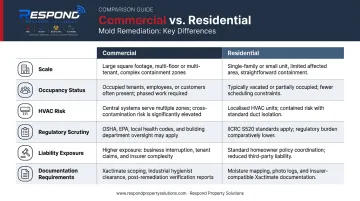
Treating commercial mold like a residential project creates serious gaps in both safety and compliance. The differences:
- Scale — Contamination zones in commercial buildings are larger and harder to bound
- Active occupancy — Work often proceeds while tenants or employees remain in the building
- Shared HVAC — A single contaminated air handler can push spores into every connected zone
- Regulatory scrutiny — Healthcare, school, and multi-tenant buildings carry stricter compliance obligations
- Liability exposure — Employer duty-of-care obligations, lease agreements, and insurance requirements all create legal risk
- Documentation requirements — Commercial remediation requires formal clearance testing and written re-occupancy certification
At commercial scale, IICRC S520-certified remediation isn't a best practice — it's the minimum acceptable response.
Why Mold Is a Serious Risk in Commercial Buildings
Health and Liability Consequences
NIOSH research estimates that dampness and mold in indoor environments are associated with 21% of current U.S. asthma cases — approximately 4.6 million people — and that exposure raises asthma risk by roughly 30–50%. Recognized symptoms tied to mold exposure include eye, nose, and throat irritation, headaches, fatigue, dizziness, and sinus congestion.
For property managers, those symptoms translate directly to rising tenant or employee complaints, increased absenteeism, and potential employer liability under duty-of-care obligations.
The OSHA Dimension
OSHA has no specific mold standard. What it does have is Section 5(a)(1), the General Duty Clause, which requires employers to maintain workplaces free from recognized hazards. A known, unaddressed mold problem — especially one where employees have reported health symptoms — can meet that threshold. OSHA's published guidance on workplace mold cites this clause as the enforcement basis.
The protective action is documentation:
- Log moisture complaints and the dates they were reported
- Record response decisions and the reasoning behind them
- Document contractor engagement and remediation scope
- Retain these as formal safety records from day one
Financial Consequences of Delay
Mold consumes organic building materials. Drywall, ceiling tiles, insulation, and wood framing don't survive deep mold infiltration — they require removal and replacement. The longer the colony has to grow, the more material crosses the line from salvageable to unsalvageable, and the higher the scope and cost climb.
Commercial mold claims regularly reach six figures, and there's a parallel policy risk: mold sublimits on commercial property policies are frequently far lower than actual remediation costs. Property managers should verify their fungi and mold endorsements before a loss, not after.
HVAC as a Distribution Network
The EPA states directly that operating a mold-contaminated HVAC system can spread mold throughout a building and increase occupant exposure across every connected zone. A roof leak above one tenant's suite becomes a building-wide contamination event the moment the air handler cycles. This is why commercial mold cannot be treated as a zone-by-zone problem. The HVAC system must be evaluated as part of any professional assessment.
How Commercial Mold Remediation Works
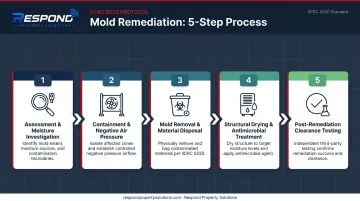
The governing standard is ANSI/IICRC S520-2024: Standard for Professional Mold Remediation. It exists because partial, ad-hoc approaches consistently fail to protect occupants and allow regrowth. Every reputable commercial remediation follows its structure.
Documentation and insurance coordination should begin at the first call. Respond Property Solutions initiates Xactimate-compatible scopes, photo documentation, and direct adjuster communication from the start — a structure that prevents scope disputes and protects property owners from claim denials.
Step 1: Assessment and Moisture Investigation
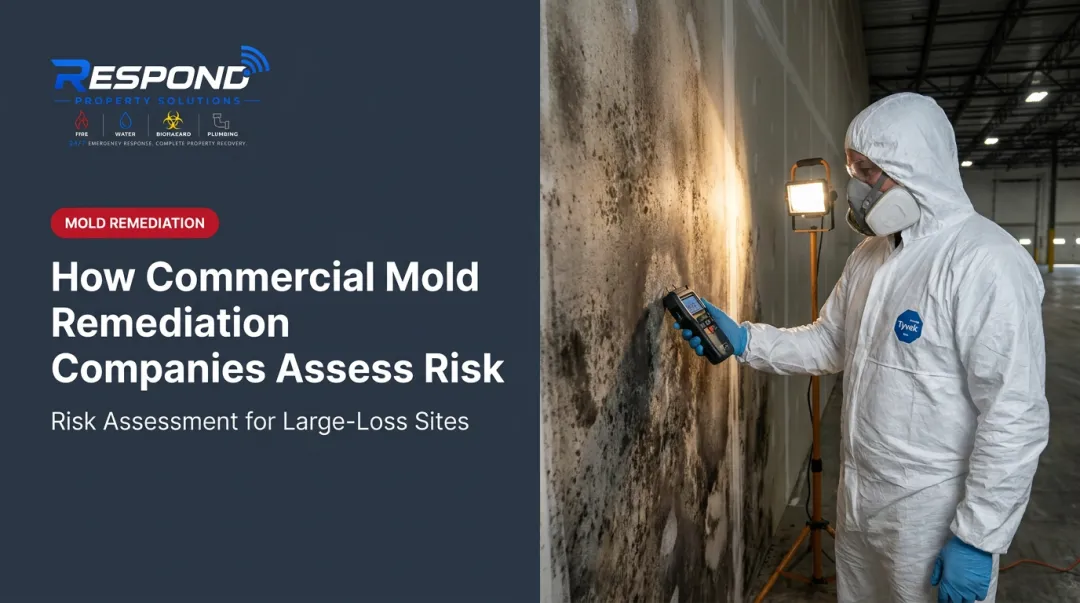
A certified remediator deploys thermal imaging cameras and moisture meters to map both visible and concealed contamination, then identifies the moisture source driving growth. Air and surface sampling establish the type and concentration of spores present.
Without thorough assessment, mold almost always returns. Crews remove what they can see and leave the underlying problem intact.
Step 2: Containment and Negative Air Pressure Control
EPA guidance defines three containment levels based on affected area:
| Affected Area | Containment Level |
|---|---|
| Less than 10 sq ft | Standard precautions may be sufficient |
| 10–100 sq ft | Limited containment required |
| More than 100 sq ft | Full containment required |
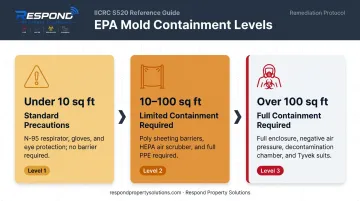
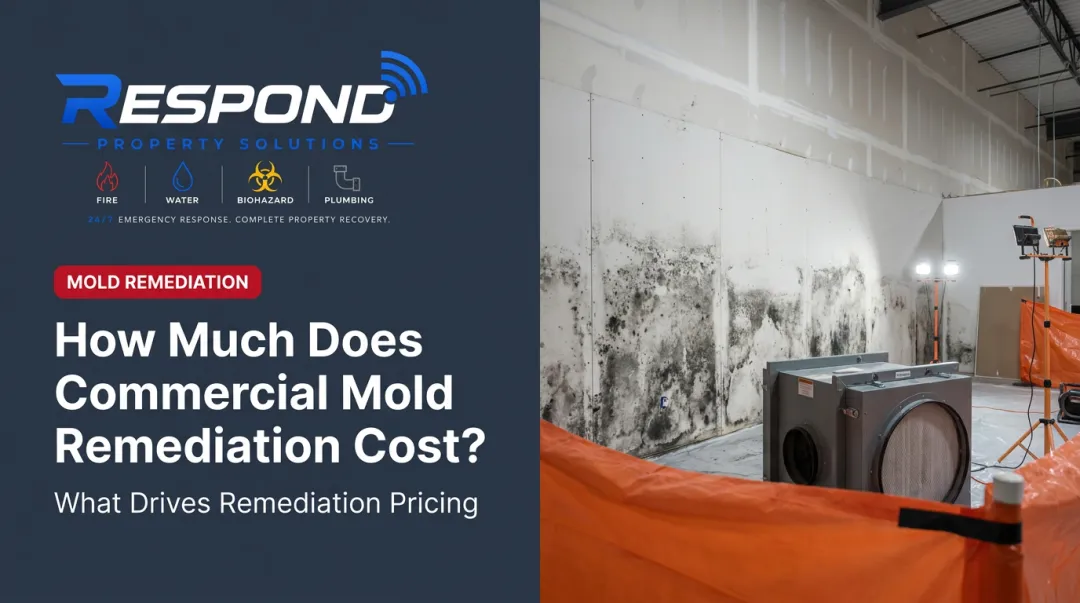
Full containment uses 6-mil fire-retardant polyethylene sheeting and HEPA-filtered negative air pressure machines. These units draw air from the contained zone and exhaust it outside, ensuring that spores dislodged during removal cannot migrate to unaffected areas.
On commercial projects, this containment design is also what allows other building zones to remain operationally active.
Step 3: Mold Removal and Material Disposal
Porous materials with deep mold infiltration (drywall, insulation, ceiling tiles, carpet) are removed and double-bagged in sealed 6-mil polyethylene before disposal as construction waste. Non-porous surfaces are HEPA-vacuumed and treated with EPA-registered antimicrobial solutions.
Standard vacuums are not acceptable for this work: they aerosolize spores and redistribute contamination. Bleach, despite its common use in facility maintenance, doesn't remediate porous materials. EPA's commercial guidance directs removal and disposal of unsalvageable contaminated materials, not surface treatment.
Step 4: Structural Drying and Antimicrobial Treatment
Once contaminated materials are removed, the remaining structure must be dried before any reconstruction begins. Industrial dehumidifiers and air movers bring affected materials to acceptable moisture content levels.
This step isn't complete until moisture meter readings confirm dryness — not when materials look or feel dry to the touch. If reconstruction begins on materials still holding elevated moisture content, mold regrows behind new drywall within weeks.
Antimicrobial coatings may be applied in high-risk areas, but these are supplementary to proper drying, not a substitute for it.
Step 5: Post-Remediation Verification and Clearance Testing
Air and surface samples from the remediated area are compared to outdoor baseline conditions. Per EPA guidance, indoor mold types and concentrations should be similar to outdoor background levels before an area is cleared for re-occupancy.
The clearance report serves three functions: re-occupancy authorization, insurance claim documentation, and legal protection. This step is frequently skipped by unqualified contractors — its presence or absence is one of the clearest signals of whether a remediation was legitimate or incomplete.
Where Mold Hides and What Drives It in Commercial Properties
Common Hotspots
These locations are difficult to identify during routine inspection because the visible surface often looks fine:
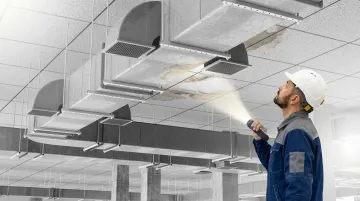
- HVAC ductwork and air handler units — spores accumulate on condensate pans and coil surfaces
- Wall cavities behind vinyl wallpaper or rigid paneling — the paper face of drywall appears clean while the back side supports active growth
- Pipe chases and utility tunnels — slow leaks go undetected for months
- Crawl spaces and mechanical rooms — low-traffic, poorly ventilated spaces rarely inspected
- Ceiling tile systems — water staining is visible, but the extent of contamination above the tile is not
Visible mold at a surface typically means the colony has been established for weeks or months — and the hidden growth behind it is almost always worse.
Regional Moisture Drivers in SoCal and Arizona
Standard commercial moisture risks apply everywhere — roof leaks, plumbing failures, HVAC condensate overflows, inadequate envelope sealing, and poor ventilation in high-occupancy zones. In Southern California and Arizona, two regional patterns add complexity:
- Arizona monsoon season runs June 15 through September 30, and according to the National Weather Service, delivers 40–50% of northern Arizona's annual precipitation in just three months. Multiple moisture events in rapid succession overwhelm roofs, drainage systems, and building envelopes that perform well the rest of the year.
- California atmospheric rivers can deliver extreme rainfall in compressed timeframes — sometimes accounting for half of the state's annual precipitation in a handful of storm days — overloading drainage and creating envelope intrusion events.
HVAC condensation is a compounding factor in both regions. Aggressive cooling cycles generate elevated moisture loads, and when condensate pans overflow or drain lines clog during peak cooling season, that moisture gets trapped inside wall assemblies or ceiling plenums where it rarely dries on its own.
Warning signs to monitor before visible mold appears:
- Persistent musty odors in specific building zones
- Unexplained increases in employee respiratory complaints
- Bubbling or peeling paint on interior walls
- Warping baseboards or floor transitions
- Recurring condensation on interior surfaces
- Water staining on ceiling tiles
Any of these conditions calls for professional moisture assessment — including moisture mapping, air sampling, and thermal imaging — before the contamination footprint expands.
Common Misconceptions About Commercial Mold Remediation
"Our facilities team can handle this with bleach and a shop vac."
This is the most damaging misconception in commercial property management. Bleach does not penetrate porous materials — EPA commercial remediation guidance calls for removal and disposal of contaminated porous materials, not surface treatment.
Standard vacuums aerosolize spores and redistribute them. Without containment and negative air pressure, cleaning activity spreads contamination to unaffected zones and can dramatically expand the remediation scope.
"We can see the mold, so we know the full extent."
Visible surface growth means the colony is already well-established — typically weeks or months in. Hidden growth behind walls, within insulation, and inside HVAC systems is almost always more extensive.
Professional moisture mapping and sampling determine the true scope — not what's visible from the surface.
"We had it remediated, so we're done."
If the underlying moisture source wasn't corrected — a slow roof leak, a condensate overflow, inadequate ventilation, a plumbing defect — mold will return regardless of how thorough the surface remediation was. The moisture fix is not a separate project; it is the remediation.
Common sources that get missed:
- Slow roof penetration leaks with no visible interior staining
- Condensate line overflows in ceiling-mounted HVAC units
- Inadequate exhaust ventilation in kitchens, restrooms, or server rooms
- Slow plumbing supply or drain leaks inside walls
Address the source, or the remediation work starts the clock on the next outbreak.
Frequently Asked Questions
What methods and products do professionals use for commercial building mold remediation?
Certified professionals use HEPA vacuums, HEPA-filtered negative air pressure machines, EPA-registered antimicrobial solutions, moisture meters, and thermal imaging cameras. Physical containment barriers isolate work zones, and all procedures follow IICRC S520 protocols. Product and method selection depends on material type — porous materials are removed, non-porous surfaces are cleaned and treated.
Is mold an OSHA violation?
OSHA has no specific mold standard, but the General Duty Clause (Section 5(a)(1)) requires employers to protect workers from recognized hazards. A known, unaddressed mold problem — particularly where employees have reported health symptoms — can expose a building owner or employer to OSHA enforcement action.
How do you test for mold in a commercial building?
Professional testing uses three methods:
- Air sampling — measures spore concentration and type
- Surface sampling — tape lifts or swabs from suspect areas
- Moisture mapping — thermal imaging and meters to locate hidden moisture
Lab results are compared to outdoor baseline samples to confirm abnormal contamination levels.
How long does commercial mold remediation take?
Small to mid-size jobs typically take 3–7 days. Large-scale projects involving HVAC systems or extensive hidden contamination can take several weeks. Timeline varies based on affected square footage, material removal scope, HVAC involvement, and clearance testing.
Can a business stay open during mold remediation?
In many cases, yes. Professional containment and negative air pressure allow remediation to proceed in isolated zones while other areas remain operational. The decision depends on contamination scope, HVAC involvement, and occupant health sensitivities — and should be confirmed with the remediation team before work begins.
Does commercial property insurance cover mold remediation?
Coverage depends on the cause. Mold from a sudden event — burst pipe, roof failure — is typically covered; mold from chronic humidity or neglect often is not. Thorough documentation (moisture readings, photos, Xactimate-compatible scope reports) is essential to a successful claim. Check your policy's mold sublimit before a loss occurs.