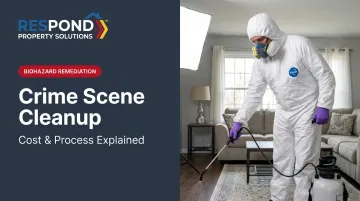
For homeowners, property managers, and families across Southern California and Arizona, this process is both a health necessity and a legal matter. The pathogens left behind after these events are invisible, dangerous, and not something any standard cleaning company is equipped to handle.
This article covers exactly what crime scene cleanup involves, what drives the cost, and how to pay for it — in plain language, without the runaround.
Key Takeaways
- Crime scene cleanup is regulated biohazard remediation, not heavy-duty cleaning — certified professionals only.
- Costs typically run $1,500 to $20,000+, depending on incident type, surface materials, and time elapsed.
- Delays after law enforcement clears the scene drive costs up — biological material penetrates porous surfaces fast.
- Homeowners insurance, auto insurance, and state victim compensation programs can offset or fully cover costs — all require professional documentation to file.
What Is Crime Scene Cleanup?
Crime scene cleanup — also called trauma scene remediation or biohazard remediation — is the professional decontamination of a property after a violent crime, suicide, homicide, or unattended death. It encompasses biological material removal, disinfection, and licensed biomedical waste disposal.
The goal is not cosmetic. The process is designed to return a property to a biologically safe condition that meets OSHA 29 CFR 1910.1030 bloodborne pathogen standards and the ANSI/IICRC S540 Standard for Trauma and Crime Scene Cleanup (2023 edition).
How It Differs From Standard Cleaning
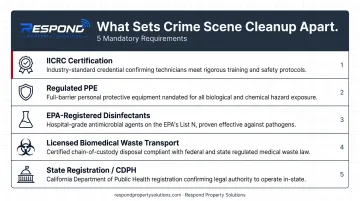
The distinction matters legally, not just technically. Crime scene cleanup requires:
- Technicians with IICRC certification in trauma and biohazard remediation — not general restoration
- Regulated PPE including gloves, gowns, face shields, and respiratory protection rated for bloodborne pathogen exposure
- EPA-registered tuberculocidal disinfectants, or products listed on EPA List S for HIV, HBV, and HCV
- Licensed biomedical waste transport with full chain-of-custody documentation
- State registration — California requires practitioners to register with the CDPH as Trauma Scene Waste Management Practitioners before performing any of this work
A janitorial company or restoration contractor without these credentials cannot legally or safely perform crime scene cleanup. Hiring an uncertified crew doesn't just risk fines — it leaves biological hazards behind that aren't visible to the naked eye.
How Crime Scene Cleanup Works: Step by Step
Cleanup begins only after law enforcement officially releases the scene. Every engagement follows a structured protocol driven by the IICRC S540 standard — from initial assessment through final clearance — to ensure no biological material is missed and all waste is legally disposed of.
Technicians bring equipment the public simply cannot access: industrial PPE, EPA-registered tuberculocidal disinfectants, HEPA vacuums, air scrubbers, odor remediation equipment, and licensed biomedical waste containers.
Step 1: Scene Assessment and Containment
Technicians first assess the full scope of contamination — mapping both visible and non-visible biological material. They then establish containment barriers and seal HVAC returns to prevent cross-contamination to unaffected areas of the property.
Step 2: Removal of Biohazardous Material
All contaminated materials are addressed. Non-porous surfaces (sealed concrete, tile, glass) are treated in place. Porous materials — carpet, padding, drywall, subflooring — that have absorbed biological material are physically removed, packaged, and labeled as regulated biohazardous waste.
This distinction directly affects cost, which we'll cover below.
Step 3: Cleaning, Disinfection, and Odor Treatment
Technicians apply EPA-registered tuberculocidal disinfectants to all affected surfaces in multiple wash cycles. Decomposition odors — which standard deodorizers cannot eliminate — are addressed using ozone generators or thermal foggers. This step targets pathogens that are invisible without testing.
Step 4: Post-Remediation Clearance and Documentation
The job closes with clearance testing to verify decontamination to a measurable standard, not just a visual check. According to industry guidance from Restoration & Remediation Magazine, the IICRC recommends visual inspection combined with ATP bioluminescence swab testing to confirm biological contamination has been eliminated.
That documentation package — pre- and post-remediation photography, waste chain-of-custody records, and scope of work — is what drives the insurance claim and satisfies regulatory compliance. For families already managing an extremely difficult situation, navigating that paperwork alone adds unnecessary burden. Respond Property Solutions provides Xactimate-compatible scope documentation and communicates directly with adjusters, removing the back-and-forth from the process entirely.
What Factors Determine Crime Scene Cleanup Cost?
Cost in this industry is driven by a handful of measurable variables. Understanding them helps families and property managers evaluate quotes with confidence.
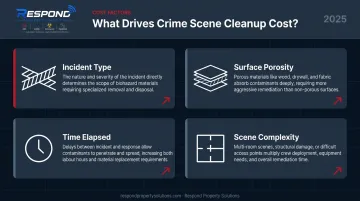
The four primary cost drivers:
- Incident type — Contained blood scenes on non-porous surfaces cost a fraction of extended decomposition cases, which require full structural remediation
- Surface porosity — Biological material on tile or sealed concrete is decontaminable through chemical wash cycles; the same material on carpet, drywall, or unsealed wood requires physical removal and regulated disposal
- Time elapsed — The longer a scene goes unaddressed after law enforcement release, the deeper biological material penetrates structural materials, increasing both labor and disposal scope
- Scene complexity — Multi-room incidents, HVAC operation during a decomposition event, and vehicle involvement each add discrete cost layers
Typical Crime Scene Cleanup Cost Ranges
The ranges below reflect estimates across incident types, sourced from published provider data. They exclude post-clearance structural repairs — flooring replacement, drywall patching, repainting — which are separate contractor costs performed only after biohazard clearance is issued.
| Incident Type | Estimated Cost Range |
|---|---|
| Contained blood scene on non-porous surfaces | $1,500 – $3,000 |
| Blood scene with carpet or drywall affected | $3,000 – $7,000 |
| Unattended death discovered within 24 hours | $3,000 – $8,000 |
| Extended decomposition with structural remediation | $7,000 – $25,000+ |
| Multi-room homicide or trauma scene | $10,000 – $25,000+ |
| Vehicle biohazard incident | $1,000 – $2,500 |
Ranges sourced from BioRecovery's 2026 biohazard cleanup cost guide and Precision Service Experts' crime scene cleanup cost breakdown. Actual costs depend on contamination volume, HVAC involvement, and time elapsed.
When requesting quotes, ask for itemized breakdowns that separately list:
- Labor hours and crew size
- Disinfectant application and PPE costs
- Licensed biomedical waste disposal fees
- Odor remediation scope
- Clearance testing fees
A lump-sum quote hides what's actually included — and what isn't.
Who Pays for Crime Scene Cleanup?
Most families assume they'll be paying out of pocket. In many cases, insurance, state programs, or both cover a significant portion of the cost.
Homeowners and Renters Insurance
Most standard HO-3 homeowners policies include coverage provisions that apply to sudden and accidental contamination events. The critical step is calling your insurer before cleanup begins to obtain a claim number.
A licensed remediation company's documentation — scope of work, waste chain of custody, and pre/post photography — is what allows the insurer to process the claim. Respond Property Solutions coordinates directly with regional insurance carriers in California and Arizona, and their Xactimate-compatible documentation is prepared from the first call so nothing stalls the claim.
State Victim Compensation Programs
When insurance falls short, state compensation programs are often available — and widely underused. Families who already paid out of pocket may still qualify retroactively.
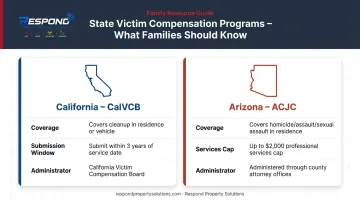
- California: The California Victim Compensation Board (CalVCB) may reimburse individuals who pay for reasonable crime scene cleanup costs when a crime occurs in a residence or vehicle. Reimbursement requests must be submitted within 3 years of the service date.
- Arizona: The Arizona Criminal Justice Commission (ACJC) administers Crime Victim Compensation through county attorney offices statewide. Per the ACJC program desk manual, crime scene cleanup may be covered for homicide, aggravated assault, or sexual assault occurring in a residence, with a professional services cap of $2,000 (note: figures from the 2018 desk manual — confirm current caps with ACJC directly).
Auto Insurance
Comprehensive auto insurance covers losses not caused by collision — and most policy definitions are broad enough to include biohazard cleanup for vehicle incidents, including unattended deaths or suicides occurring in a vehicle. The remediation company must provide a professional scope confirming the vehicle required biohazard remediation, not standard cleaning.
Out-of-Pocket and Payment Options
When insurance is insufficient or delayed, reputable remediation companies can often defer payment pending insurance settlement. Don't delay calling for professional cleanup over immediate payment concerns. Biological delay increases both health risk and total cost.
Common Misconceptions About Crime Scene Cleanup
"Any professional cleaning company can handle this."
No. Crime scene cleanup is a regulated biohazard remediation discipline governed by OSHA 29 CFR 1910.1030 and the IICRC S540 standard. Technicians require specific certifications, licensed biomedical waste transporter credentials, and regulated PPE. A cleaning company without these credentials cannot legally perform this work.
In California, operating without CDPH registration as a Trauma Scene Waste Management Practitioner is a legal violation — not a paperwork technicality.
"Cleanup includes repairs and restoration."
Biohazard remediation ends at biological clearance. It does not patch drywall, replace flooring, repaint walls, or restore the property to its pre-event appearance. Those are separate contractor services performed after the remediation company issues a post-clearance certificate.
"If it looks clean, it's safe."
Visual inspection alone is not an adequate clearance standard. Bloodborne pathogens survive on surfaces long after visible traces disappear:
- Hepatitis B (HBV) remains infectious on surfaces for at least 7 days
- Hepatitis C (HCV) can survive on dry surfaces and equipment for up to 6 weeks
Neither is visible. Professional ATP clearance testing — not visual inspection — is the appropriate standard for declaring a scene safe.
Frequently Asked Questions
How much does it cost to clean up a crime scene?
Costs typically range from around $1,500 for small, contained scenes on non-porous surfaces to $25,000 or more for extended decomposition requiring structural remediation. The primary variables are incident type, surface materials affected, time elapsed since the event, and number of rooms involved.
Is crime scene cleanup worth it?
Professional cleanup is not optional when biohazardous material is present. Bloodborne pathogens like HBV and HCV survive on surfaces for days to weeks, and exposure without certified PPE creates direct health and legal liability. Insurance or state victim compensation programs typically offset the cost.
Is crime scene cleanup covered by insurance?
Most standard homeowners and auto insurance policies cover crime scene cleanup under sudden and accidental contamination clauses. State victim compensation programs provide an additional funding source for qualifying victims. Contact your insurer before cleanup begins to open the claim correctly.
Does crime scene cleanup include repairs and restoration?
No. Biohazard remediation ends at biological clearance — it does not replace flooring, repaint walls, or patch drywall. Structural and cosmetic repairs are performed separately, only after the remediation company issues a post-clearance certificate confirming the space is biologically safe.
How long does crime scene cleanup take?
Most single-room scenes on non-porous surfaces are completed in a few hours. Multi-room scenes, vehicle incidents, or decomposition cases requiring structural remediation can take one to several days. Law enforcement scene release must occur before remediation begins.
Can I clean up a crime scene myself?
Don't attempt DIY cleanup. OSHA bloodborne pathogen standards require specific PPE, certified training, and licensed biomedical waste disposal that the public cannot legally access. Improper handling creates direct health risk and may disqualify an insurance claim that would otherwise cover the full professional cost.