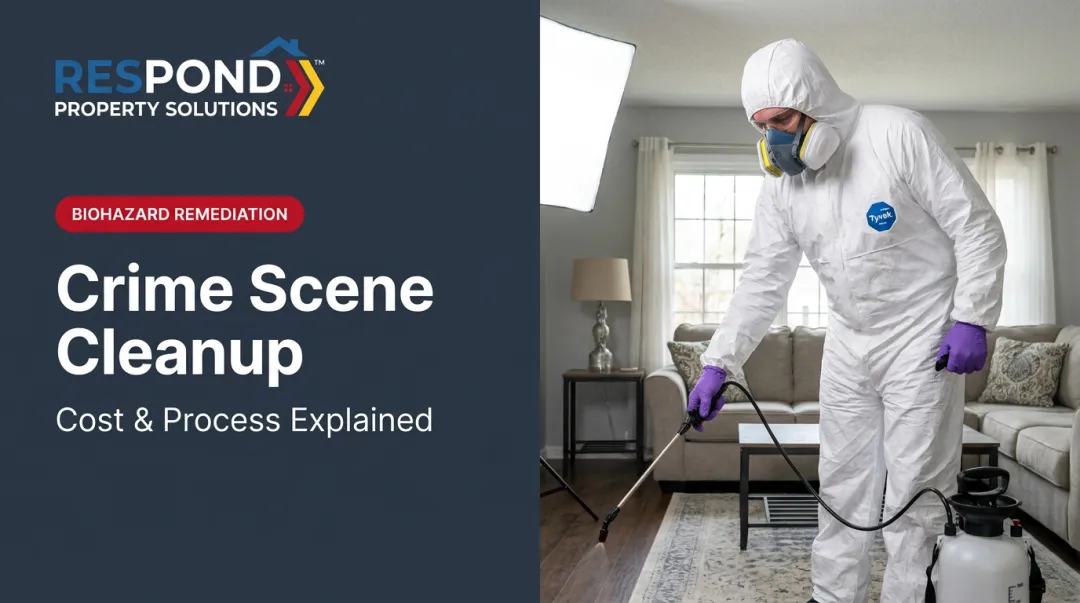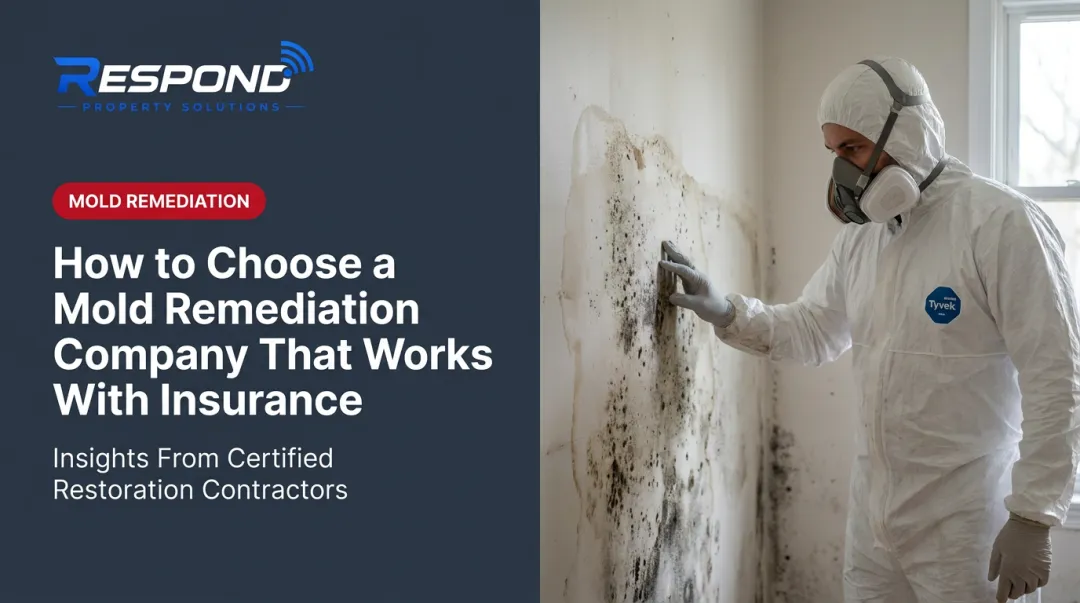
This guide covers the qualifications to verify, the six factors that matter most in your selection, and the warning signs that should send you looking elsewhere.
Key Takeaways
- Verify IICRC certification, OSHA Bloodborne Pathogen training, and a certificate of insurance before anyone starts work
- Biological contamination worsens by the hour — response time is not a minor detail
- Demand a written, itemized scope of work; verbal quotes are a warning sign
- Qualified companies produce Xactimate-compatible documentation and coordinate directly with your adjuster
- Technicians who arrive without proper PPE or cannot explain their disposal process are disqualifying
What Biohazard Cleanup Actually Involves
Biohazard cleanup is the professional removal, disinfection, and disposal of biological and chemical hazards — including blood, bodily fluids, decomposition matter, sewage, animal waste, and narcotics residue — using specialized equipment and EPA-approved agents. This work is categorically different from standard janitorial services.
Situations requiring professional biohazard response include:
- Crime and trauma scenes
- Unattended or undiscovered deaths
- Suicide and homicide scenes
- Hoarding situations with biological contamination
- Clandestine drug labs (including meth and fentanyl processing sites)
- Sewage backups classified as Category 3 contamination
- Infectious disease decontamination
Each situation requires its own protocol. Trauma scene cleanup follows bloodborne pathogen standards; drug lab remediation operates under EPA's voluntary methamphetamine laboratory cleanup guidelines — a completely separate regulatory track.
The Regulatory Framework
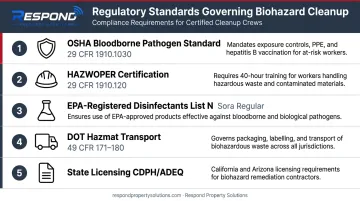
Legitimate cleanup crews must be trained and compliant across overlapping federal and state requirements. Knowing these standards helps you verify a company's credentials before hiring:
- Bloodborne pathogen training required under OSHA 29 CFR 1910.1030 for any crew handling blood or infectious materials
- HAZWOPER certification (OSHA 29 CFR 1910.120) for hazardous waste operations and emergency response work
- EPA-registered disinfectants only — products on EPA List N must be applied per label directions
- Hazmat transport compliance under DOT 49 CFR Parts 171–180 for infectious substance disposal
- State licensing: California requires CDPH registration for trauma scene waste practitioners; Arizona requires ADEQ approval for biohazardous waste transporters
Why Hiring an Unqualified Company Is a Serious Risk
Pathogens Survive Longer Than Most People Expect
The health risk from incomplete cleanup is not hypothetical. According to the CDC, hepatitis B virus remains infectious on surfaces for at least 7 days. Peer-reviewed research found viable hepatitis C virus in dried spots for up to 6 weeks under experimental conditions. HIV behaves differently — the CDC notes a 90–99% concentration reduction within several hours of drying — but any blood contamination event should be treated as a regulated exposure risk until professionally cleared.
An unqualified crew that wipes down visible surfaces and calls the job done leaves invisible hazards behind.
Legal Consequences of Non-Compliant Disposal
Biohazardous waste cannot go in the trash. In California, trauma scene waste management practitioners — companies that handle trauma scene cleanup — must register with CDPH before any cleanup begins. First-offense violations can result in misdemeanor charges with fines starting at $2,000; civil penalties for failure to register can reach $10,000 per violation. In Arizona, biohazardous medical waste transporters must be ADEQ-approved.
Property owners who hire non-compliant companies face regulatory consequences directly. Before signing anything, ask exactly how waste will be transported and disposed of — and verify the answer.
Documentation Failures That Derail Insurance Claims
Without a properly itemized scope of work, photo documentation, and an insurer-compatible estimate, adjusters may deny portions of the cleanup cost. The California Department of Insurance advises claimants to maintain receipts, bills, and photographs to support claims. A cleanup company that cannot produce this documentation from day one creates a financial problem on top of an already difficult situation. Confirm upfront that the company delivers Xactimate-compatible scopes with photo documentation — that paper trail is what protects your claim.
6 Factors to Look for When Choosing a Biohazard Cleanup Company
Certifications and Technical Training
Certifications are the baseline — not a bonus feature. Look specifically for:
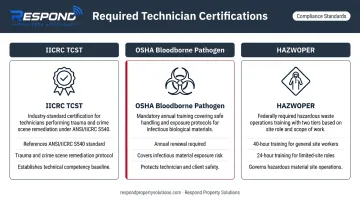
- IICRC TCST (Trauma and Crime Scene Technician) — based on ANSI/IICRC S540, the industry standard for trauma and crime scene cleanup
- OSHA Bloodborne Pathogen certification — required for any worker with occupational exposure to blood or potentially infectious materials, with annual renewal
- HAZWOPER training — required for workers involved in hazardous waste operations; 40-hour training for general site workers, 24-hour for limited-exposure roles
Ask directly: "Are your technicians IICRC certified and OSHA trained?" A legitimate company confirms this without hesitation and can provide credentials on request.
Licensing, Insurance, and Legal Compliance
Beyond certifications, verify:
- Certificate of insurance — Request this before work begins; it should confirm both general liability and workers' compensation coverage. California law requires workers' compensation for all employers, even with a single employee.
- State-specific waste hauler registration — In California, ask for CDPH trauma scene practitioner registration. In Arizona, verify ADEQ transporter approval.
- Disposal chain — Ask specifically: where does the waste go, and who transports it? Vague answers here are a dealbreaker.
24/7 Availability and Response Time
Biological contamination worsens with time. Pathogens spread, odors set into porous materials, and structural damage accelerates. A company that cannot mobilize within hours is not equipped for emergency biohazard response.
Before committing, ask:
- What is your guaranteed on-site response time?
- Do calls reach a live local dispatcher or a third-party call center?
- Can you confirm 24/7 availability, including holidays?
The dispatcher question matters most. At 2 a.m., you need someone who can send a crew — not take a message.
Insurance Coordination and Documentation
Most homeowner and commercial property policies cover biohazard remediation related to covered events, though coverage varies by policy and peril. A qualified company should:
- Work directly with your insurance adjuster on your behalf
- Produce Xactimate-compatible scopes, the estimating format most carriers require
- Provide photo documentation starting on day one
- Keep you out of the back-and-forth so you're not navigating the claims process alone
Any company that says they "don't deal with insurance" or pushes for immediate out-of-pocket payment before discussing coverage should be treated with caution.
Transparent Pricing and a Written Scope of Work
Project costs vary significantly. Industry benchmarks from HomeAdvisor and Fixr place typical biohazard cleanup in the $3,000–$5,000 range, with major sewage backups or extensive crime scene restoration reaching $25,000.
These are planning benchmarks — actual costs depend on contamination type, affected area, porous material removal, waste volume, and documentation requirements.
Before any work begins, you should receive a written document that clearly outlines:
- What work will be performed and which materials removed
- How biohazardous waste will be disposed of and by whom
- The estimated timeline
- A fixed price or an explicit method for how costs will be calculated
Verbal quotes and unusually low bids with vague scope descriptions frequently result in surprise charges mid-job or incomplete remediation that requires a second company to finish.
Reputation, Discretion, and Compassionate Service
Technical competence matters — so does how a company treats people in the worst moments of their lives. When reviewing feedback, look specifically for mentions of professionalism, compassion, and discretion — not just whether the physical job was completed.
Verify that the company:
- Conducts background checks on technicians entering private residences
- Maintains confidentiality about the situation
- Has a verifiable online history and BBB record
Red Flags That Should Make You Walk Away
Some warning signs are disqualifying on their own. Walk away if you encounter:
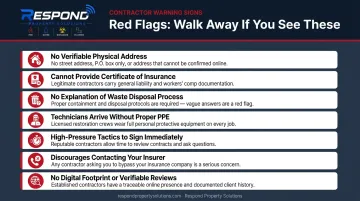
- No verifiable physical address — PO boxes or a purely online presence with no branch locations
- Cannot provide a certificate of insurance — Non-negotiable before work begins
- No answer on waste disposal — If they can't explain how biohazardous waste will be handled and disposed of, they shouldn't be on your property
- Technicians show up without hazmat suits, gloves, and respirators — proper PPE is non-negotiable for any legitimate crew
- High-pressure tactics to sign immediately — Reputable companies give you time to review documents and consult your insurer; urgency is a predatory tactic
- They discourage you from calling your insurance company — any company that steers you away from your insurer likely can't support a legitimate claim
- No digital footprint — Absence of verifiable reviews, no online history, and unwillingness to provide references, especially when combined with any of the behaviors above
The FTC advises consumers in emergency situations to compare estimates, verify contractors, and watch for payment pressure. That standard applies here — if something feels off before work starts, it will almost certainly get worse once it does.
How Respond Property Solutions Serves Southern California and Arizona
Respond Property Solutions is a full-service disaster restoration contractor with dedicated biohazard cleanup capabilities across Southern California and Arizona. Five branches — El Centro, Yuma, Redlands, Palm Springs, and Riverside — cover San Diego, Imperial, Riverside, San Bernardino, Orange, La Paz, and Yuma counties.
Operating since 1991 under the QRV Network quality standard, now referenced in insurer Service Level Agreements, Respond brings verified credentials and direct insurer coordination to every biohazard job.
Biohazard services include:
- Trauma scene cleanup — unattended deaths, suicide, homicide
- Hoarding response
- Drug lab and fentanyl decontamination
- Industrial contamination and hazardous chemical spills
- General biohazard decontamination
Every technician is IICRC certified and operates under the QRV Network standard, which requires verified training, background checks, licensing, and insurance across all branches. All biohazard work is OSHA-compliant and conducted with full discretion.
Each job is handled against the same criteria you'd use to vet any biohazard contractor:
- Live answer in 45 minutes, crew on-site in 2–4 hours, 24/7/365 — no third-party call centers, no transfer queues
- One project manager owns the job from first call through final walkthrough, eliminating documentation gaps when jobs change hands
- Xactimate-compatible scopes, photo documentation from day one, and direct adjuster communication — mitigation begins inside the policy window on every job
- QRV Network compliance requires verified training, background screening, licensing, and audited insurance at every branch
Call 866.867.3123 for 24/7 emergency biohazard response across Southern California and Arizona.
Frequently Asked Questions
What does biohazard cleanup include?
Biohazard cleanup covers the professional removal of blood, bodily fluids, decomposition matter, and other hazardous biological or chemical materials. This includes disinfection with EPA-registered agents, odor remediation, and compliant waste disposal. It requires specialized equipment, trained technicians, and licensed waste transport — not standard cleaning services.
How much does biohazard cleanup cost?
Costs vary based on contamination type, affected area, and whether structural materials must be removed. Industry benchmarks place typical projects between $3,000 and $5,000, with major events reaching $25,000 or more. Many cleanup events are covered fully or partially by homeowner's or commercial property insurance.
What certifications should a biohazard cleanup company have?
At minimum, technicians should hold IICRC TCST certification and OSHA Bloodborne Pathogen certification. HAZWOPER training applies when the job involves hazardous waste operations. State-specific requirements — such as CDPH registration in California and ADEQ approval in Arizona — are also mandatory.
Does homeowner's insurance cover biohazard cleanup?
Many policies cover biohazard remediation related to covered events such as accidental death or crime. Coverage depends on your specific policy, the peril involved, and your deductible. Contact your insurer promptly and choose a cleanup company with insurance documentation experience to avoid claim complications.
How long does biohazard cleanup take?
Duration depends on the contaminated area's size, the biohazard type, and whether structural materials need removal. A single contained room may take several hours; severe or widespread contamination can run multiple days. A reputable company provides a written timeline estimate before work begins.
Can I clean up a biohazard scene myself?
DIY biohazard cleanup is strongly discouraged and, in many cases, illegal. Handling blood or biological materials without proper PPE, training, and licensed disposal methods creates serious health risks and regulatory violations. Professional remediation is the only way to confirm a space is truly safe to reoccupy.