Most property owners and facility managers know they need to act fast. Fewer know exactly what to do, in what order, and when the situation has exceeded in-house response capacity.
This guide covers all three: what emergency decontamination actually is, the precise steps for both personnel and surfaces, and the preventive measures that reduce the likelihood of a crisis — or limit its severity when one occurs.
Key Takeaways
- Emergency decontamination prioritizes speed over thoroughness — every second of contact time increases contamination risk
- The core sequence is: evacuate, remove contaminated clothing, flush exposed skin, and actively dry
- OSHA identifies contact time as a primary factor in contaminant permeation; delay directly worsens outcomes
- Proper PPE, written SOPs, and trained staff are the three pillars of contamination prevention
- Contamination that reaches structural materials, HVAC systems, or porous surfaces requires certified restoration — in-house response is not enough
What Is Emergency Decontamination?
OSHA defines decontamination as "the process of removing or neutralizing contaminants that have accumulated on personnel and equipment" to prevent foreseeable adverse health effects. Emergency decontamination is a specific application of that process — one where speed takes clear precedence over thoroughness because delay risks loss of life or severe injury.
That urgency applies across four contaminant categories responsible for most property-level incidents:
- Physical — Sediment, dust, debris, contaminated PPE residue
- Chemical — Solvents, acids, caustics, pesticides, process chemicals (common in industrial and commercial facilities)
- Biological — Bloodborne pathogens, sewage organisms, mold-contaminated materials (relevant in healthcare, multi-family, and residential properties)
- Radiological — Radioactive industrial gauges, lab sources, contaminated dust
Levels of Decontamination
FEMA PRISM defines three distinct levels — and understanding where each fits matters for anyone building a response plan:
| Level | Definition | When It Applies |
|---|---|---|
| Emergency | Decontamination by any available means — dry absorbents or water | Immediate life-safety response before organized resources arrive |
| Gross | High-volume, low-pressure water mist through a corridor | Once the scene is partially controlled |
| Technical | Specialist decontamination units, trained crews, hospital-level resources | Complex or unknown agents requiring dedicated equipment |
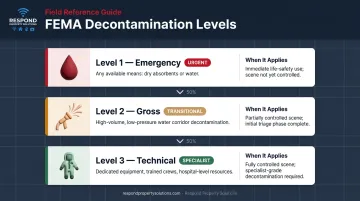
Most property-level incidents start at emergency decontamination and escalate from there — which level you're operating at determines the resources, timeline, and personnel your response plan needs to account for.
Emergency Decontamination Steps
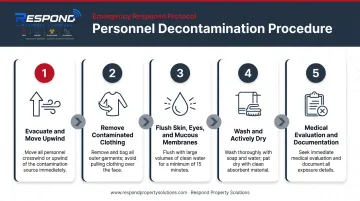
FEMA's PRISM guidance identifies four immediate priorities for personnel: evacuate, disrobe, decontaminate, and actively dry. Here is the full sequence to execute on-site.
Body and Personnel Decontamination
Step 1 — Evacuate and move upwind
Remove the affected person from the contaminated area immediately. Move crosswind or upwind to prevent continued inhalation or skin contact. Don't allow them to walk through clean zones; secondary contamination of unaffected areas starts at this step.
Step 2 — Remove contaminated clothing and PPE
CDC guidance states that removing clothing can eliminate 80–90% of surface contaminants, though published evidence on this figure remains limited. Disrobing is still the single highest-impact action available and should happen before any other decontamination step.
Remove outer garments carefully, rolling them inward rather than pulling over the head. Bag and label everything immediately.
Step 3 — Flush exposed skin, eyes, and mucous membranes
Use clean water at low pressure and high volume. FEMA supports high-volume, low-pressure mist for a specific reason: higher-pressure methods can increase skin penetration rates for certain contaminants. Flush eyes for a minimum of 10–15 minutes (NIOSH guidance supports at least 15 minutes for chemical exposures). Prioritize open wounds and broken skin.
Step 4 — Wash thoroughly, then actively dry
Scrub from head to toe with a gentle cleaning agent. After any wet decontamination, towel-dry the skin — FEMA specifically identifies active drying as assisting physical removal of residual contaminant. Do not re-enter the contaminated area without full PPE.
Step 5 — Seek medical evaluation and document the exposure
Get professional medical care regardless of whether symptoms are present because some exposures take hours to manifest. Log the contaminant type, exposure duration, affected skin area, and all parties involved. This documentation matters for regulatory compliance, insurance coordination, and any follow-up medical care.
Surface and Equipment Decontamination
Once personnel have been treated, attention shifts to the surfaces and equipment that remain contaminated. Left unaddressed, these become ongoing exposure sources.
Physical removal comes first. Scrape, brush, or wipe away gross contamination before applying any liquid ; applying cleaning solution to heavily contaminated surfaces spreads the agent rather than neutralizing it. Workers performing this step need gloves, goggles, and respiratory protection.
For biohazardous materials (blood, bodily fluids, sewage), a freshly prepared bleach solution is the standard disinfectant. WHO guidance supports 0.5% bleach for blood and body fluid spills; CDC supports a 1:10 bleach dilution for large blood spills in healthcare settings.
Contact time matters. Allow approximately 10 minutes per label instructions before rinsing to ensure the disinfectant works fully.
Containment of contaminated materials is required by regulation and critical to preventing spread:
- Place all contaminated towels, clothing, brushes, and equipment in sealed, labeled biohazard or hazardous waste containers
- Collect contaminated wash water and keep it from reaching drains or uncontrolled areas
- OSHA's Bloodborne Pathogens standard requires waste containers to be closable, leak-resistant, and labeled before removal
What Happens When Decontamination Is Delayed or Skipped
The 1995 Tokyo subway sarin attack stands as the most documented example of what delayed field decontamination produces at scale. The attack caused 12 deaths and approximately 5,500 people harmed — and reviews of the medical response found that 23% of St. Luke's hospital staff experienced secondary exposure because patients arrived without having been decontaminated in the field. Responders became casualties because the contamination problem was transported rather than contained.
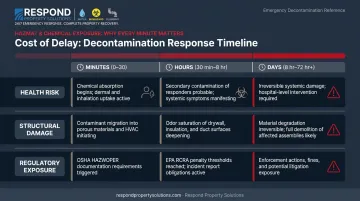
The mechanism is straightforward. OSHA states that the longer a contaminant remains in contact with skin or equipment, the greater the probability and extent of permeation. FEMA reinforces this: the most effective chemical decontamination procedures are those performed within minutes of exposure.
At the property level, delayed decontamination creates compounding problems:
- Chemical absorption, infection risk, and secondary contamination of responders and bystanders all increase with contact time
- Structural damage spreads faster than expected — contaminants left on porous materials, HVAC systems, or building surfaces migrate, causing degradation, odor saturation, and material loss
- OSHA's HAZWOPER framework makes decontamination programs enforceable; EPA's RCRA policy treats failure to contain discharged hazardous waste as a penalty trigger
Warning Signs Decontamination Was Inadequate
- Persistent chemical or biological odors after initial cleanup
- Visible staining, discoloration, or residue on surfaces
- Personnel reporting ongoing symptoms — skin irritation, respiratory issues, nausea — hours after the event
When these signs appear, the incident hasn't ended. It has moved into a phase that requires certified professional remediation, not additional in-house effort.
Respond Property Solutions is an IICRC-certified restoration contractor serving Southern California and Arizona. At this stage, their role is straightforward: assess what contamination remains, remediate affected building materials to clearance, and coordinate directly with your insurer throughout the process.
How to Prevent Contamination Emergencies at Your Property
Prevention works as a set of layered practices that reduce both the likelihood of a contamination event and the severity of its consequences. OSHA identifies written Standard Operating Procedures as the critical first step.
Establish Written SOPs and a Decontamination Plan
A written, site-specific contamination response plan should define:
- Decontamination station locations
- PPE requirements by role and contaminant type
- Procedures for isolating and zoning affected areas
- Disposal protocols for contaminated materials and wash water
OSHA's HAZWOPER standard requires that decontamination procedures be developed, communicated, and implemented before employees or equipment enter areas where exposure may occur — not after an incident prompts the question.
Conduct scheduled drills. A plan that exists only on paper provides no value when an event is unfolding in real time.
Enforce Proper PPE Selection and Inspection
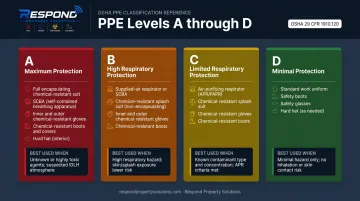
Match PPE to the specific contaminant type and concentration. OSHA's Level A–D framework guides selection:
- Level A: Full encapsulation suit — highest skin, respiratory, and eye protection for unknown or highly toxic agents
- Level B: Supplied-air respirator with chemical-resistant splash protection
- Level C: Air-purifying respirator where the contaminant type and concentration are known
- Level D: Standard work uniform — appropriate only for minimal hazard environments
Pre-use inspection is mandatory. OSHA's decontamination guidance requires checking PPE for cuts, punctures, and deterioration before use. Workers with skin injuries should not perform decontamination duties — OSHA notes that cuts and scratches directly enhance the potential for chemicals to penetrate the body, increasing absorption risk.
Minimize Direct Contact and Control Hazardous Material Storage
Direct contact with hazardous materials is the most controllable risk factor. Practical measures include:
- Remote handling tools — drum grapplers, pneumatic wrenches, bagged monitoring instruments
- Strippable protective coatings on tools and equipment
- Plastic sheeting or overpacks around contamination sources before handling
For storage, OSHA's HazCom standard (29 CFR 1910.1200) governs chemical labeling, Safety Data Sheets, and container requirements. EPA's 40 CFR 264/265 container rules require hazardous waste containers to be compatible with the waste they hold. Routine audits of storage areas for leaks, container degradation, and labeling failures catch the conditions that most commonly precede accidental releases.
Train All Personnel Before an Incident Occurs
Training should cover every staff member who may encounter hazardous substances — including maintenance, janitorial, and facilities personnel, not just designated safety staff. The goal isn't rote memorization of a procedure. Workers who understand the reasoning behind each step can adapt when real conditions differ from the planned scenario.
HAZWOPER (29 CFR 1910.120) applies to workers at covered hazardous waste and emergency response sites, with annual refresher requirements for trained personnel.
Tips for Long-Term Decontamination Readiness
Sustained preparedness requires ongoing investment beyond initial prevention measures:
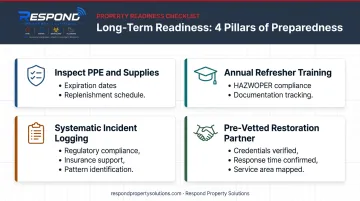
- Inspect PPE and supplies regularly — Check expiration dates on bleach solutions, biohazard bags, absorbents, and rinse stations; replenish before supplies run low, not after they're needed
- Require annual refresher training — Document completion and track certifications; HAZWOPER compliance applies to workers at covered sites and mandates annual refreshers for applicable roles
- Maintain systematic incident logs — Documentation serves regulatory compliance, supports insurance claims, and reveals patterns that inform prevention improvements
- Establish a pre-vetted restoration partner before you need one — Vetting credentials, response times, and service area coverage under pressure costs time you won't have mid-crisis
Respond Property Solutions offers a complimentary Pre-Loss Planning service for property managers and facility managers across Southern California and Arizona. The program includes risk assessment, response coordination protocols, and documentation that accelerates recovery and simplifies insurance claims.
With five branches across San Diego, Imperial, Riverside, San Bernardino, Orange, La Paz, and Yuma counties — plus 24/7/365 live dispatch and crews on-site within 2–4 hours — having Respond in place before an emergency eliminates the search delay entirely.
Combining internal prevention with a professional response plan is what consistently shortens recovery time and reduces total cost — for any contamination event, at any scale.
Frequently Asked Questions
What are the methods of emergency decontamination?
Emergency decontamination combines two approaches: physical removal (rinsing, wiping, clothing removal) and chemical removal (neutralization or disinfection with solutions like diluted sodium hypochlorite). Both are typically applied at the same time, since speed of contaminant removal outweighs procedural precision in the first minutes of response.
What is the most common method of emergency decontamination?
Water-based flushing — specifically a low-pressure, high-volume rinse of exposed skin — is the most universally used method. Clothing removal paired with a water rinse is the standard first response because it rapidly reduces the contaminant load without requiring specialized equipment or trained personnel.
Who performs emergency decontamination?
Initial emergency decontamination is performed by trained first responders, hazmat teams, or on-site safety personnel. In a property or facility context, trained staff handle the immediate response while certified restoration crews handle thorough surface and structural remediation once the scene is stabilized.
What is the difference between emergency decontamination and gross decontamination?
Emergency decontamination is the fastest possible life-safety response, using any available means with speed as the primary priority. Gross decontamination follows as a more organized process, typically passing individuals through a high-volume water corridor, and is performed once the scene is partially controlled and resources are in place.
What should be done with contaminated clothing and materials after decontamination?
All contaminated clothing, towels, brushes, and materials must be placed in sealed, labeled biohazard or hazardous waste containers. Contaminated wash water must be collected separately — it cannot be discharged to drains — and items that cannot be fully decontaminated should be bagged and held for certified disposal.
How quickly should emergency decontamination begin after exposure?
Decontamination should begin within minutes of exposure — ideally within one minute, per expert consensus cited by NCBI StatPearls. FEMA identifies immediate decontamination as the most effective approach for chemical exposure, as even a short delay significantly increases absorption and injury severity.