For commercial properties, that question is harder to answer than most contractors will admit upfront. Unlike residential mold remediation, where national averages from Angi hover around $2,368 for a typical home, commercial projects span an enormous range — from a few thousand dollars for a contained single-room job to well over $100,000 for large-loss contamination involving HVAC systems or structural damage.
This guide is built for commercial decision-makers: property managers, facility directors, and building owners who need to understand the cost drivers, budget realistically, and avoid the scope disputes that come from underfunded projects.
Key Takeaways
- Commercial mold remediation ranges from $2,000 for small contained jobs to $500,000+ for large-loss properties with HVAC or structural involvement
- Scope drives cost more than square footage: HVAC involvement, building type, and moisture source repairs all compound the final number
- Regulated facilities (healthcare, food service, schools) carry additional compliance costs beyond the remediation itself
- Mold can begin colonizing within 24–48 hours of a moisture event — faster response directly limits total remediation scope
- Contractors who provide Xactimate-compatible documentation reduce claim delays and out-of-pocket costs
Commercial Mold Remediation Cost Ranges
Commercial mold remediation is priced on scope, property type, and operational complexity — not a flat per-square-foot rate. Two 500 sq ft jobs in different buildings with different systems can have wildly different price tags.
What these ranges generally include: containment setup, remediation labor, HEPA air scrubbing, disposal of affected materials, antimicrobial treatment, and post-remediation air quality verification.
What they typically exclude:
- Structural repairs
- HVAC replacement
- Plumbing fixes
- Business interruption losses
These excluded costs are real — and often equal or exceed the remediation invoice itself.
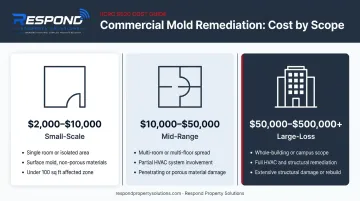
Small-Scale Commercial Jobs ($2,000–$10,000)
Covers surface or localized mold in a single room, restroom, storage area, or small office. Scope includes containment setup, removal of affected materials (drywall, ceiling tiles), antimicrobial treatment, and air quality verification.
Typical candidates: small office suites, retail units, single-tenant commercial spaces, or early-detected mold within 10–100 sq ft — the EPA's defined threshold for medium-scope contamination.
Mid-Range Commercial Jobs ($10,000–$50,000)
Jobs in this range typically involve multi-room or multi-floor contamination, partial HVAC involvement, and affected drywall and insulation across a wing or floor. Expect possible temporary business disruption, plus Xactimate-ready documentation for insurance coordination.
Common property types: mid-size office buildings, multi-family units, and schools — particularly where mold spread from an undetected water intrusion over weeks or months.
Large-Loss Commercial Remediation ($50,000–$500,000+)
At this scale, remediation typically covers:
- Whole-building contamination across multiple systems
- Full HVAC remediation or replacement
- Structural repairs and industrial-grade containment
- Large crew deployment over an extended timeline
- Full insurer coordination with photo documentation
This tier applies to healthcare facilities, hospitality properties, warehouses, and industrial buildings — especially where mold has gone undetected for an extended period.
Note on these ranges: Published contractor benchmarks vary widely, and no single authoritative source publishes verified commercial cost figures. Treat these ranges as a starting point — your actual number depends on the variables below.
Key Factors That Drive Commercial Mold Remediation Cost
Commercial mold remediation pricing is shaped by physical, operational, and regulatory variables. Each one can shift your project cost by thousands of dollars — knowing them upfront prevents scope surprises.
Scope and Square Footage
The EPA classifies mold remediation by affected area: small (under 10 sq ft), medium (10–100 sq ft), and large (over 100 sq ft). Contractor-published benchmarks typically cite $10–$25 per sq ft as a working range, though this escalates quickly when mold grows behind walls, inside structural cavities, or along shared building systems.
The sq ft figure also understates scope when porous materials are involved. Contractors remove and replace mold-contaminated drywall, insulation, and ceiling tiles — cleaning alone isn't sufficient — which adds labor and material costs that don't show up in a simple area calculation.
HVAC System Involvement
HVAC remediation is one of the most expensive line items on a commercial mold project. Commercial HVAC systems are far more complex than residential units, and the EPA advises shutting down any contaminated HVAC system immediately to prevent spore distribution throughout the building.
NADCA standards require commercial HVAC remediation to cover:
- Component inspection and contamination classification (Condition 2 or 3)
- Source removal, coil treatment, and drain-pan cleaning
- Cleanliness verification after work is complete
- Replacement of porous or flood-exposed components
Chemical shortcuts don't apply. The EPA has not approved disinfectants or fungicides for use in HVAC ductwork, so mechanical source removal is required across the board.
Budget HVAC remediation as a separate cost center. It can add tens of thousands of dollars to a project that might otherwise fall in the mid-range.
Mold Type and Toxicity
More hazardous mold species — Stachybotrys (black mold), Aspergillus — require full containment barriers, higher-grade PPE, stricter disposal protocols, and post-remediation air quality verification. These requirements drive cost.
The EPA's framework escalates protocols based primarily on affected area and contamination condition, not species alone. In practice, the cost difference between a Stachybotrys job and a Cladosporium job of the same size comes down to containment level and disposal requirements. For commercial properties, mold identification still matters — regulatory or liability documentation often requires species-level testing.
Building Type and Occupancy
Not all commercial buildings carry the same compliance burden:
- Healthcare facilities require ICRA (Infection Control Risk Assessment) protocols — access control, infection containment barriers, and sequenced work that protects vulnerable patients. CDC guidance calls for removal and replacement of structural materials not dried within 48–72 hours.
- Schools follow EPA's mold remediation guidance for commercial buildings, with containment requirements that trigger at 10 sq ft.
- Food service establishments may face full closure requirements pending local or state health authority approval before reopening.
- Warehouses and storage facilities typically operate under lower compliance burdens, which can significantly reduce total project cost.
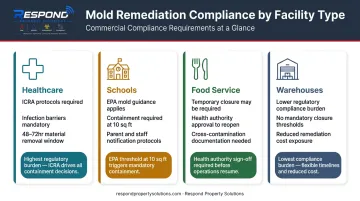
The pattern across regulated facilities is consistent: compliance creates cost through access control, documentation requirements, extended timelines, and closure authority — not through a published national surcharge.
Moisture Source and Structural Damage
Mold remediation alone doesn't fix the problem if the moisture source remains. Roof leaks, plumbing failures, and HVAC condensation issues must be addressed as part of or alongside the remediation scope. These repairs are typically billed separately and can match or exceed the remediation cost itself.
FEMA confirms mold colonies can begin forming on damp surfaces within 24–48 hours. An unresolved moisture source creates active re-growth conditions that can invalidate a completed remediation entirely.
Hidden and Additional Costs to Budget For
The remediation scope is only one part of total project cost. Property managers who budget only for mold removal consistently encounter significant additional expenses.
Common additional cost categories:
- Pre-remediation inspection and air quality testing — Commercial IAQ investigations typically run $900–$2,000+; industrial hygiene or OSHA compliance studies can reach $1,000–$5,000+
- Post-remediation clearance testing — Often required for insurance claims or regulatory compliance; budget this separately, not as part of the remediation invoice
- Structural repairs — Drywall, framing, and flooring replacement after material removal; frequently excluded from base remediation quotes
- Temporary HVAC repairs or rentals — Needed to maintain air circulation during remediation when systems are shut down
Business interruption is often the largest uncounted expense. According to Restoration & Remediation Magazine, small business disruption losses can range from $23,600 to $255,000 per event. A full 10-day shutdown versus partial operations for 4–5 days can represent a cost difference that dwarfs the remediation invoice itself, particularly for hospitality, healthcare, or retail properties with lease obligations and revenue tied to occupancy.
Commercial vs. Residential: Why the Numbers Are Different
Residential mold remediation averages around $2,368 nationally. Using that number to budget a commercial project is one of the most common ways property managers end up in scope disputes — the structural differences are too significant to ignore.
Here's what separates the two:
| Factor | Residential | Commercial |
|---|---|---|
| Affected footprint | Single home | Multi-floor, multi-system |
| HVAC complexity | Single-zone systems | Multi-zone, shared ductwork |
| Regulatory requirements | Minimal | Varies by occupancy type |
| Documentation standard | Basic scope | Xactimate-compatible, insurer-coordinated |
| Insurance structure | Homeowners policy | Commercial property, fungus exclusions, sublimits |
Commercial insurance policies differ from homeowners policies. IRMI notes that fungi, mold, and bacteria exclusions have been introduced into virtually all standard commercial property and liability forms. Coverage typically depends on whether the mold resulted from a sudden, covered peril — and the claim structure requires formal documentation that aligns with commercial policy requirements, not residential formats.
That documentation requirement connects directly to contractor selection. ANSI/IICRC S520-2024 governs professional mold remediation across residential, commercial, and institutional settings. For commercial work, requiring an IICRC-certified contractor is often a prerequisite for insurance coordination and regulatory compliance — not simply a quality preference.
How to Budget for Commercial Mold Remediation
Start With a Professional Assessment
Phone estimates for commercial mold are unreliable. The full extent of contamination is rarely visible without moisture mapping, air sampling, and structural inspection. Projects that skip this step routinely run over budget when hidden growth is discovered mid-remediation.
The most defensible first step is an on-site assessment by an IICRC-certified contractor — one that produces a documented, insurer-ready scope before any remediation begins.
Request Documentation-Ready Scopes of Work
When evaluating contractors, ask specifically for itemized estimates that align with insurance adjuster requirements. Xactimate-compatible line-item estimates allow adjusters to review and approve scope faster, which reduces both claim delays and out-of-pocket exposure while authorization is pending.
Respond Property Solutions delivers Xactimate-compatible scopes, full photo documentation, and direct adjuster communication from the first call. One project manager handles insurer coordination and sub-trade scheduling from initial assessment through final walkthrough — no handoffs, no documentation gaps.
For commercial clients, that single-point accountability structure is what prevents the scope disputes that inflate final costs.
Review Your Insurance Policy Before an Event
Commercial mold coverage hinges on cause. Most policies cover mold resulting from a sudden, covered water loss — a burst pipe or roof failure. Common exclusions include:
- Mold from long-term neglect or deferred maintenance
- Fungus sublimits that cap payouts below actual remediation costs
- Pollution exclusions that can reclassify microbial growth entirely
Reviewing these provisions before an event — not after — lets you respond faster and with documentation that matches what adjusters need to approve the claim.
Prioritize Rapid Response
Mold growth can begin within 24–48 hours of water intrusion. Each additional day of unchecked spread can compound remediation scope dramatically. A $10,000 single-room job that isn't contained promptly can become a $100,000 multi-floor project within days.
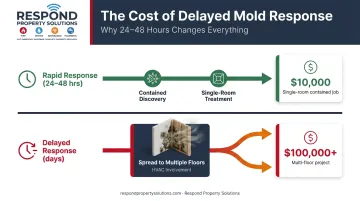
Respond Property Solutions operates 24/7/365 with a 45-minute dispatch standard and 2–4 hour on-site arrival across Southern California and Arizona — five branches covering San Diego, Imperial, Riverside, San Bernardino, Orange, La Paz, and Yuma counties. For commercial properties, the difference between immediate containment and a delayed response often determines which cost tier a project lands in.
Frequently Asked Questions
How much does professional mold removal cost?
Residential averages run around $2,368 nationally. Commercial projects range from roughly $2,000 for small contained jobs to $500,000 or more for large-loss properties with HVAC involvement or structural damage. An on-site professional assessment is the only reliable way to generate an accurate number for a specific commercial property.
Will insurance cover commercial mold remediation?
Commercial policies often cover mold when it results from a sudden, covered peril — a burst pipe or roof failure, for example. Mold from long-term neglect or deferred maintenance is usually excluded. Fungus sublimits and endorsement structures vary significantly by policy, so prompt documentation and adjuster notification matter from day one.
How long does commercial mold remediation take?
Small single-room jobs typically take 1–3 days. Large-loss projects involving HVAC systems, multiple floors, or structural repairs can take several weeks. Business operations may need to be partially or fully suspended in affected areas, and downtime is a real cost that should be factored into the total project budget.
What's the difference between mold remediation and mold removal?
"Mold removal" implies complete elimination, which the EPA confirms is impossible — mold spores are always present indoors. Professional remediation returns mold to normal, non-harmful concentrations and eliminates active growth. That distinction matters for insurance documentation, regulatory compliance, and tenant communication.
How do I know if my commercial property needs mold remediation?
Key indicators include visible mold growth, persistent musty odors, recent water damage or HVAC leaks, tenant health complaints, and failed air quality tests. Any property with unmitigated moisture intrusion should be professionally assessed — hidden growth behind walls or in ductwork is common and often more extensive than surface signs suggest.
Does commercial mold remediation require closing the business?
It depends on the location and extent of contamination. Localized jobs in isolated, unoccupied areas may not require full closure. HVAC system involvement or contamination in occupied spaces typically necessitates at least partial shutdown to protect occupants and prevent spore spread during active remediation work.