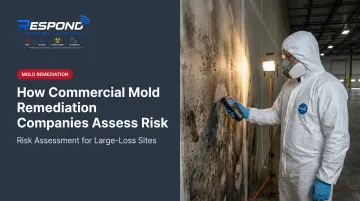
For commercial property owners, that timeline creates compounding risk. Every day without a structured response expands the contamination zone, raises remediation costs, and increases exposure to OSHA's General Duty Clause — which requires employers to provide a workplace free from recognized hazards.
Before any physical remediation work begins, certified companies conduct a formal risk assessment to determine contamination scope, classify severity, and build a defensible remediation plan. The quality of that assessment directly shapes outcomes for occupants, operations, and insurance claims.
Key Takeaways
- A commercial mold risk assessment is a structured, multi-step process covering contamination scope, moisture source, mold species, and occupant risk
- Affected square footage, occupancy type, and HVAC involvement are the three primary factors driving risk classification
- Air and surface sampling is warranted when contamination is hidden, health complaints are active, or insurance documentation is needed
- EPA guidance classifies mold risk into three tiers based on affected square footage, which determines required containment and PPE protocols
- Delaying assessment allows colonies to spread, expanding remediation scope, costs, and liability
What Is a Commercial Mold Risk Assessment?
A commercial mold risk assessment is the investigative process a certified remediation company uses to identify the presence, source, extent, and health risk of mold contamination in a non-residential building before any physical work begins.
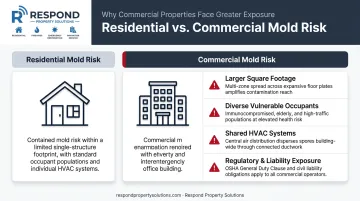
Commercial assessments differ substantially from residential ones:
- Larger square footage allows contamination to span multiple zones before anyone detects it
- Employee, patient, student, and guest populations carry widely varying vulnerability levels
- Shared air-handling systems can distribute spores building-wide if contaminated and left running
- Commercial properties carry OSHA General Duty Clause obligations and civil liability exposure that residential settings typically don't
Assessments can be reactive — triggered by visible mold, a water event, or occupant health complaints — or proactive, conducted as part of scheduled due diligence or pre-purchase inspection. Reactive assessments address an active problem; proactive ones establish a defensible baseline before a problem becomes a liability.
The governing professional standard is ANSI/IICRC S520, which establishes procedures for mold remediation of damaged structures and contents. EPA's Mold Remediation in Schools and Commercial Buildings guide (EPA 402-K-01-001) provides the area-based classification framework that defines containment and PPE requirements.
Why Risk Assessment Matters Before Remediation Begins
Launching remediation without a proper assessment is one of the most common and costly errors in commercial mold response. EPA warns that disturbing mold colonies without containment planning can aerosolize spores and spread contamination to previously clean areas — turning a localized problem into a building-wide one.
The business and liability stakes are real. Under OSHA's General Duty Clause, employers can be cited when a recognized hazard exists and reasonable steps weren't taken to prevent or abate it — and mold qualifies. Courts have awarded damages in the tens of millions in commercial mold cases where property owners failed to respond adequately.
A structured assessment closes those gaps before work begins.
What a Proper Assessment Enables
A thorough assessment provides:
- Accurate scope and cost estimation, so hidden contamination uncovered during demolition doesn't trigger mid-project budget surprises
- Containment level selection calibrated to affected square footage and occupant exposure risk per EPA guidelines
- Protocol adjustments for sensitive populations — immunocompromised patients in healthcare facilities and students in schools require more conservative approaches than a standard office
- Insurance-ready documentation from day one, including photo records, moisture readings, and scope narratives built for adjuster review
How Commercial Mold Remediation Companies Assess Risk — Step by Step
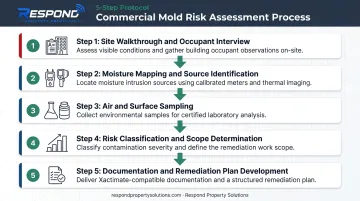
A professional commercial mold risk assessment follows a defined investigative sequence. Each stage builds on the last. Skipping any step — particularly moisture source identification — is where assessments most often fail to protect the property.
Step 1: Site Walkthrough and Occupant Interview
Assessors systematically examine known high-risk zones, including:
- HVAC systems and air handlers
- Wall cavities near plumbing lines
- Ceiling tiles below roof penetrations
- Basements, crawl spaces, and areas with documented water events
Visual indicators include visible mold growth, water staining, peeling paint, and musty odors. Occupant interviews run parallel to this inspection — recurring moisture complaints, leak history, or reports of respiratory irritation provide critical context that shapes both where the assessor looks next and how urgently they classify initial risk.
Step 2: Moisture Mapping and Source Identification
OSHA confirms that moisture meters can measure moisture content in carpet, wallboard, wood, brick, and concrete — and assessors use them alongside thermal imaging to map hidden saturation behind building materials where mold may already be growing without visible signs.
Without a confirmed moisture source, no remediation plan is complete. Whether it's a slow pipe leak, HVAC condensate pan overflow, roof intrusion, or inadequate vapor barrier, the underlying cause must be identified and addressed.
Without that fix, regrowth is a certainty — regardless of how thoroughly surface contamination is removed.
NIOSH's Dampness and Mold Assessment Tool uses a structured 0–3 scoring system for damage/stains, visible mold, wetness, and odor — supporting the kind of documented, repeatable inspection that holds up to insurer and regulatory scrutiny.
Step 3: Air and Surface Sampling (When Warranted)
Sampling is not always necessary. EPA guidance states that when visible mold is present, sampling is usually unnecessary — and CDC/NIOSH does not recommend routine air sampling because measured concentrations can't be interpreted against health-based standards (none currently exist at the federal level).
Sampling becomes warranted when:
- Contamination is suspected but not visible, and the source is unclear
- Occupants are reporting active health symptoms
- A particularly toxic species like Stachybotrys is suspected
- Documentation is needed for insurance claims or litigation
The primary sample types used in commercial assessments are air samples (spore trap or impaction cassettes), surface swabs or tape lifts, and bulk material samples.
Results must be analyzed by an accredited laboratory. AIHA's Environmental Microbiology Laboratory Accreditation Program (EMLAP) is the primary accreditation body for labs specializing in mold analysis. Findings are then interpreted against outdoor control samples by experienced professionals.
Step 4: Risk Classification and Scope Determination
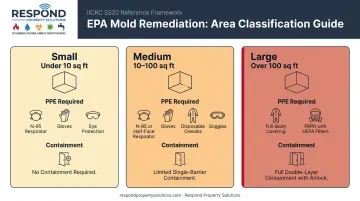
Assessors translate inspection and sampling data into a risk classification using the EPA's area-based framework:
| EPA Tier | Affected Area | Containment Required | PPE Level |
|---|---|---|---|
| Small | Under 10 sq ft | Generally not required | N-95 respirator, gloves, eye protection |
| Medium | 10–100 sq ft | Limited containment (single 6-mil polyethylene barrier) | Gloves, disposable overalls, goggles, N-95 or half-face respirator |
| Large | Over 100 sq ft | Full containment (double polyethylene layers + airlock) | Full-body covering, PAPR with HEPA filters |
Square footage isn't the only factor. Certain conditions elevate classification regardless of size:
- Active HVAC involvement — EPA requires HVAC systems to be shut down if contamination is suspected; contaminated systems need remediation by personnel experienced in HVAC cleanup
- Return-air plenum contamination — heavy mold on ceiling tiles above a plenum can spread spores building-wide; EPA recommends upgrading filters to at least MERV 8 during remediation
- Occupant vulnerability — healthcare, schools, and senior care facilities require more conservative protocols
- Hidden mold behind vapor-barrier materials — vinyl wallpaper and intact drywall can mask significant behind-wall contamination that field measurements may underestimate
Step 5: Documentation and Remediation Plan Development
The completed assessment deliverable includes:
- Written scope of work with photo documentation
- Moisture meter readings logged by location
- Floor plan markings of affected zones
- Sampling results and lab reports (if collected)
- Phased remediation plan addressing both mold removal and moisture source correction
For commercial properties, this documentation serves multiple downstream purposes:
- Forms the basis for insurer review and direct adjuster coordination
- Protects the property owner against liability by demonstrating due diligence
- Provides a benchmark for post-remediation clearance testing
- Allows a single project manager to maintain continuity from assessment through final sign-off
What a Risk Assessment Looks Like in Practice
What a Risk Assessment Looks Like in Practice
A property manager at a mid-size office building notices a musty odor in a second-floor conference room following an HVAC condensate line leak that went undetected for several weeks.
What the Assessor Finds
- Initial walkthrough: visible mold on ceiling tiles, discoloration on adjacent drywall
- Moisture mapping: elevated readings extending into the wall cavity and ceiling plenum above, expanding the confirmed scope well beyond what was visible
The Classification Decision
Once hidden plenum contamination is factored in, the affected area exceeds 100 sq ft. The assessor classifies this as a large-area event requiring:
- Full containment with double polyethylene barriers and a decontamination airlock
- HEPA-filtered negative air pressure throughout remediation
- Full PPE for all remediation workers
- HVAC shutdown and inspection to prevent further spore distribution through the return-air plenum
Why Documentation Matters Here
The property manager receives a written, phased work plan that minimizes occupied-space disruption. The insurance adjuster receives photo-documented, Xactimate-compatible scope from day one. The remediation team works to defined clearance criteria, so re-occupancy decisions rest on documented results rather than guesswork.
How Respond Property Solutions Assesses and Responds to Commercial Mold Risk
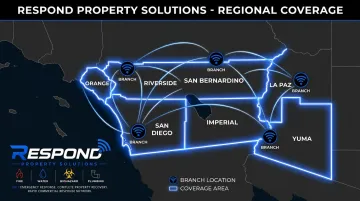
Respond Property Solutions operates across Southern California and Arizona as an IICRC S520-certified mold remediation provider. Its Respond Environmental Solutions division handles the full assessment scope: mold inspection, containment, remediation, air-quality clearance, and indoor environmental assessment.
That certification structure matters because every assessment is built to satisfy regulatory and insurance requirements from the first on-site hour. Respond operates under the QRV Network quality standard it established in 1991 — a standard insurers now reference directly in their Service Level Agreements.
What the response window looks like for commercial clients:
With 5 branch locations across SoCal and Arizona covering Riverside, San Bernardino, Orange, Imperial, San Diego, La Paz, and Yuma counties — Respond's crews can be on-site within 2–4 hours of a call, with live dispatch answering in under 45 minutes. Risk assessment and containment planning begin within that critical window before mold spread accelerates.
What commercial clients and insurance professionals receive:
- A single project manager who owns the job end-to-end — no handoffs between assessment, remediation, and closeout
- Xactimate-compatible scope documentation with photo evidence produced from the first site visit
- Direct adjuster communication so the transition from risk assessment to approved remediation doesn't stall on documentation gaps
For property managers dealing with a moisture event or suspected mold, reaching Respond early means a documented assessment is already in place before scope uncertainty drives up costs or delays carrier approval.
Frequently Asked Questions
What does a mold remediation assessment consist of?
A commercial mold assessment includes a visual inspection of at-risk areas, moisture mapping using meters and thermal imaging, and (where warranted) air or surface sampling to determine spore levels and mold species. It concludes with a written scope of work that drives the remediation plan and supports insurer review.
What are the EPA guidelines for mold remediation?
The EPA's Mold Remediation in Schools and Commercial Buildings guide classifies contamination by affected area — small (under 10 sq ft), medium (10–100 sq ft), and large (over 100 sq ft) — with corresponding containment, PPE, and professional-engagement requirements for each tier. Because no federal threshold limits for airborne mold concentrations exist, site-specific sampling and professional judgment determine acceptable post-remediation clearance levels.
How do mold remediation companies determine what level of containment is needed?
Containment level is determined by total affected surface area, potential for occupant exposure, HVAC involvement, and whether sensitive populations are present. Larger or more complex contamination requires double-barrier containment with negative air pressure systems and HEPA-filtered exhaust.
When should a commercial property owner call a mold remediation company?
Call a professional immediately if any of the following apply:
- Visible mold covers more than 10 sq ft
- Water intrusion was not fully dried within 48 hours
- Occupants report persistent musty odors or respiratory symptoms
- Mold is suspected inside HVAC systems or wall cavities
How long does a commercial mold risk assessment take?
On-site assessment for a standard commercial space generally takes 2–4 hours. When air or surface sampling is collected, lab turnaround adds one to three business days before a finalized remediation plan is delivered.
Can a mold risk assessment report be used for an insurance claim?
Yes. A properly documented assessment — including photo evidence, moisture readings, a written scope of work, and sampling results — is typically required by insurers to approve and price a commercial mold remediation claim. Working with a company that produces Xactimate-compatible documentation from the start directly speeds up the claims process.