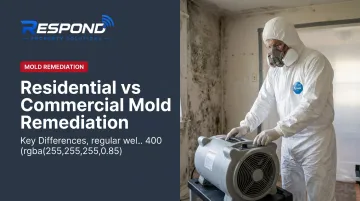
Homeowners who hire a residential-only crew for a multi-unit property risk compliance gaps that can trigger tenant liability issues. Commercial operators who apply a residential mindset to a regulated facility risk OSHA violations and prolonged downtime. The stakes differ because the properties differ — not just in size, but in regulatory exposure, stakeholder complexity, and documentation requirements.
According to the EPA, mold can begin colonizing wet materials within 24–48 hours of water intrusion, making the speed and scope of the response as important as the approach itself.
This guide covers the core process of each type, where they diverge across five critical dimensions, and how to determine which approach your property actually requires.
Key Takeaways
- Both property types follow the same remediation science, but commercial jobs layer in compliance, documentation, and coordination requirements
- Residential remediation prioritizes occupant health and minimal disruption to daily family life
- Commercial remediation must satisfy OSHA standards, EPA guidelines, and multi-party coordination demands
- Equipment scale, crew size, documentation standards, and clearance requirements differ significantly between the two
- Choosing the right company means verifying IICRC certification, relevant property-type experience, and adjuster-ready documentation
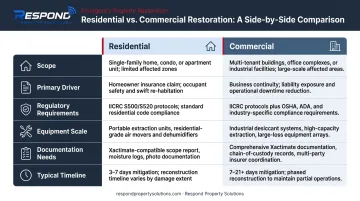
Residential vs. Commercial Mold Remediation: At a Glance
Here's how residential and commercial mold remediation compare across the dimensions that matter most:
| Dimension | Residential | Commercial |
|---|---|---|
| Typical Scope | 1–3 rooms, single-family or small multi-family | Multiple floors, suites, or HVAC systems |
| Primary Driver | Occupant health, homeowner insurance claim | Liability, compliance, business continuity |
| Regulatory Requirements | IICRC S520, homeowner insurance protocols | OSHA, EPA guidelines, local health codes, industry-specific rules |
| Equipment Scale | Localized containment, smaller crew | Industrial containment, anterooms, negative air pressure, rotating crews |
| Documentation Needs | Moisture readings, photos, written scope | Daily logs, air quality data, scope reports, adjuster-ready formats |
| Typical Timeline | Days | Days to weeks |
Scope and Scale
Residential jobs are contained: typically one to three rooms, a single crew, and a finite set of equipment. Physical barriers seal the affected zone at the room level.
Commercial jobs operate at a different order of magnitude. Remediation may span entire floors, mechanical systems, or multi-suite footprints. Industrial containment with anterooms and continuous negative air pressure is standard. Rotating crews allow work to continue in phases while other areas of the building remain operational.
Compliance and Documentation
Residential remediation is primarily driven by homeowner insurance claims. Basic moisture readings, photos, and a written scope are the documentation baseline. Post-remediation clearance testing is common but not universally mandated.
Commercial remediation carries a broader compliance burden. OSHA's workplace mold guidance and the EPA's Mold Remediation in Schools and Commercial Buildings guide both apply. Regulated industries such as healthcare, schools, and food service layer on additional air quality mandates. Expected documentation includes:
- Formal scope reports with daily air quality logs
- Independent post-remediation clearance testing
- Adjuster-ready formats for insurer coordination
What Is Residential Mold Remediation?
Residential mold remediation is the process of identifying, containing, removing, and treating mold growth in owner-occupied or small residential properties. The goal isn't total elimination — that's impossible, and the EPA is explicit about it. The goal is restoring mold to safe, naturally occurring levels by fixing the moisture source and removing visible growth.
Common triggers include:
- Slow plumbing leaks behind walls or under sinks
- Bathroom and laundry room condensation
- Basement or crawl space moisture intrusion
- Improperly sealed roofs or windows
- Post-flood conditions
Because mold colonizes within 24–48 hours of water exposure, response time is the first variable that determines how contained the job stays.
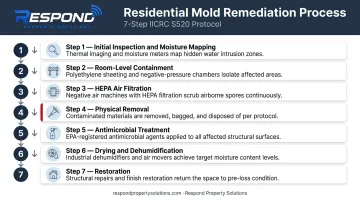
The Residential Remediation Process
A properly executed residential job follows these steps:
- **Initial inspection and moisture mapping** — identifying affected materials and hidden moisture pockets using thermal imaging
- Room-level containment — physical barriers, sealed vents, and doorways to prevent cross-contamination
- HEPA air filtration — air scrubbers running continuously during active remediation
- Physical removal — infested drywall, insulation, and carpeting come out entirely
- Antimicrobial treatment — salvageable surfaces are treated to inhibit regrowth
- Drying and dehumidification — structural materials brought to acceptable moisture content
- Restoration — rebuilding affected areas to pre-loss condition
The Occupant Experience Matters
What separates quality residential remediation from adequate remediation is how the crew treats the people living through it. Families need to know what to pack out, which paths are safe, when they can return to different areas, and what the timeline looks like at each phase.
Respond Property Solutions assigns a single project manager to every residential job. That means:
- One point of contact from first call through final walkthrough
- Direct adjuster communication handled by the project manager, not the homeowner
- No handoffs between departments, no conflicting updates
Common Residential Mold Scenarios
- Bathroom and laundry rooms — chronic humidity without adequate ventilation
- Basements — moisture intrusion following flooding or groundwater seepage
- Crawl spaces — ground moisture wicking upward into structural materials
- Attics — roof leaks or inadequate ventilation creating ideal mold conditions
Residential remediation is almost always coordinated with a homeowner's insurance claim. Documentation formatted to support the claims process — moisture readings, photos, written scope — isn't a bonus feature. It's how a homeowner gets paid.
Respond Property Solutions produces Xactimate-compatible scopes with direct adjuster communication from day one. Claims move faster when documentation is built in from the start, not assembled after the work is done.
What Is Commercial Mold Remediation?
Commercial mold remediation applies to businesses, multi-family housing, industrial facilities, healthcare settings, schools, hospitality properties, and office buildings. In these environments, mold is a health risk, a compliance problem, and a business continuity threat — one that grows more costly with every day the property stays out of service.
What Makes Commercial Mold Jobs Different
Several factors drive complexity in commercial settings that don't exist in residential work:
- HVAC networks can spread spores across entire floors before visible growth appears. The CDC notes mold enters buildings through vents and HVAC systems, making inspection a required component of any commercial scope
- High occupant density creates coordination requirements with tenants, property managers, and security
- Regulated industries — healthcare facilities and schools — carry additional air quality mandates beyond standard OSHA and EPA guidance
- Financial downtime accumulates for every day a property or section of it remains unusable
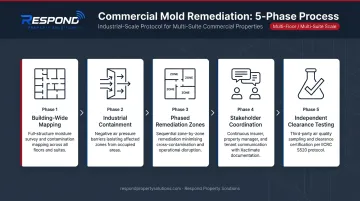
The Commercial Remediation Process
Commercial remediation scales up from the residential model in several ways:
- Building-wide moisture and spore mapping across multiple floors and suites before remediation begins
- Industrial containment with anterooms and continuous negative air pressure logging
- Phased remediation zones that allow clean areas to remain operational while affected zones are treated
- Coordination with property managers, tenants, and security for access and scheduling
- Mandatory independent clearance testing before full reoccupation
The documentation layer is its own category of work. Commercial jobs require daily logs, air quality readings, scope reports, and photo documentation formatted for commercial property insurers. In regulated industries, additional compliance records apply on top of that.
Xactimate-compatible scopes with direct adjuster communication determine whether a claim moves in days or months — and that distinction matters when a property is generating zero revenue.
Why a Single Project Manager Matters at Scale
On a multi-floor commercial mold job, the most common failure points occur at transitions: when responsibility passes between crews, when documentation is compiled by multiple hands, when an adjuster receives conflicting accounts.
A single project manager who owns the job from first assessment through final clearance eliminates those gaps. Every crew reports to the same authority. Every documentation decision flows through one accountable person.
Respond Property Solutions structures every commercial job this way — one project manager, end-to-end accountability, across all five branches serving Southern California and Arizona. Dispatch runs 24/7/365 with 2–4 hour on-site response for multi-family complexes, hotels, healthcare facilities, schools, and industrial sites.
Common Commercial Mold Scenarios
- Office buildings after roof leaks or pipe failures
- Multi-family complexes following plumbing events affecting shared systems
- Hotels — high humidity combined with high occupancy creates persistent mold risk
- Schools and healthcare facilities with strict air quality regulations and immunocompromised occupants
- Industrial and warehouse spaces with moisture-prone storage areas
Key Differences: Where Residential and Commercial Remediation Diverge
Regulatory and Compliance Requirements
Residential work is primarily governed by IICRC S520 standards and homeowner insurance protocols. The standard — ANSI/IICRC S520-2024 — covers both property types, but commercial remediation adds mandatory compliance layers that residential work does not carry.
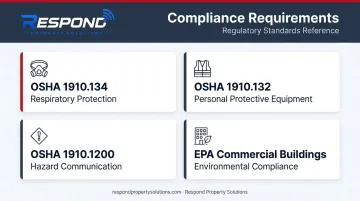
In healthcare, schools, and food service settings, multiple federal and state regulations apply directly to remediation workers:
- OSHA 1910.134 — respiratory protection standards
- OSHA 1910.132 — PPE requirements
- OSHA 1910.1200 — hazard communication rules
- EPA commercial buildings guidance — environmental compliance overlay
In California specifically, Health and Safety Code Section 17920.3 classifies visible mold and dampness as substandard building conditions subject to code enforcement. That's a concrete liability for commercial property owners who delay remediation.
Stakeholder Coordination
In a residential job, a project manager works with one or two homeowners. In commercial remediation, the coordination matrix expands fast:
- Building owners and property managers (different approval chains)
- Multiple tenants with varying schedules and access requirements
- Security staff controlling building access
- Insurance adjusters managing the claim
- Potentially local health authorities in regulated settings
Each group has different priorities and can create delays if not managed proactively. Contractors without genuine commercial experience routinely underestimate this coordination load — and projects stall.
Documentation and Insurance Handling
Residential claims require moisture reports and photos to support a homeowner's claim. Commercial claims require:
- Formal scope-of-work documentation
- Daily logs and air quality data
- Clearance test results
- All of it in a format that satisfies commercial property insurers — and in some cases, regulators
Xactimate-compatible documentation matters for commercial property owners because it aligns directly with how commercial insurers process claims. A scope built in Xactimate format doesn't need to be translated before an adjuster can act on it, which removes a major source of claim delay.
Post-Remediation Clearance and Accountability
Both residential and commercial jobs should end with a clearance test. In commercial settings, that test is typically required rather than recommended, must be conducted by an independent third party, and results may need to be shared with tenants, health authorities, or building certification bodies before reoccupancy is permitted.
The ANSI/IICRC S520-2024 standard draws a clear line between Post Remediation Evaluation (conducted by remediators) and Post Remediation Verification (conducted by independent indoor environmental professionals). For commercial properties, PRV is the expected standard — not optional.
This distinction adds time and cost to commercial projects. Property managers who don't account for the PRV step in their initial planning are the ones most likely to miss reoccupancy deadlines.
Choosing the Right Approach — and the Right Company
Residential remediation is the right scope for owner-occupied homes and small residential properties with isolated mold growth.
Commercial remediation protocols apply to any income-generating property, regulated facility, or multi-tenant building — regardless of how large the mold appears to be. Compliance and documentation requirements attach to the property type, not the square footage of visible growth.
What to Look for in a Mold Remediation Company
- IICRC certification at the crew level — verify technicians hold credentials like the Applied Microbial Remediation Technician (AMRT), not just the company as a whole
- Experience with your specific property type — residential expertise and commercial expertise are not interchangeable
- Insurance-adjuster-ready documentation — Xactimate-compatible scopes, photo documentation, direct adjuster communication
- 24/7 emergency availability — mold doesn't start at business hours, and the 24–48 hour response window is unforgiving
- A single point of contact from assessment through restoration
Respond Property Solutions has operated under its own QRV Network quality standard since 1991, with IICRC-certified crews across five branches serving Southern California and Arizona — San Diego, Imperial, Riverside, San Bernardino, Orange, La Paz, and Yuma counties. Every job gets one project manager from first call to final walkthrough. Their dispatch line is answered live, not routed through a call center, with crews typically on-site within 2–4 hours.
Homeowners should look for clear communication, direct adjuster coordination, and a company that keeps the process moving so you're not living around the work longer than necessary.
Commercial property owners and managers face a higher bar. Proven documentation practices, scalable crew capacity, and formal compliance protocols aren't optional — a remediation partner that falls short on any of these creates liability exposure and operational disruption that outlasts the mold itself.
Conclusion
Residential and commercial mold remediation are not the same job at different sizes. They differ in regulatory requirements, stakeholder complexity, equipment scale, documentation standards, and accountability chains. The right approach is determined by the type of property involved — not just the extent of visible growth.
For homeowners, the right remediation partner means a faster return to comfort and a smoother insurance claim. For commercial property owners and managers, it means avoiding compliance liability, protecting tenants, and limiting the operational disruption that grows with every day a property stays out of service.
Whether you're dealing with a single affected room or a multi-floor commercial facility, Respond Property Solutions handles both — with IICRC-certified crews, direct insurer coordination, and a single project manager accountable from the first call to the final walkthrough. Call 866.867.3123 any time, 24/7/365.
Frequently Asked Questions
What is the difference between mold removal and mold remediation?
Mold removal focuses on physically cleaning visible mold from surfaces. Remediation goes further: it addresses the underlying moisture source, removes affected materials, and restores mold to safe, naturally occurring levels — because, as the EPA confirms, complete elimination of indoor spores is impossible.
Is professional mold removal worth it?
Yes. Mold recolonizes quickly if the moisture source isn't resolved, which is the step most DIY cleanups skip. Professionals use HEPA vacuums, air scrubbers, and moisture mapping tools to identify hidden growth and verify drying — capabilities that household cleaning products and fans can't replicate.
How do I choose a mold remediation company?
Start with these criteria:
- IICRC certification at the technician level (specifically the AMRT credential)
- Demonstrated experience with your property type
- Ability to produce insurance-adjuster-ready documentation
- 24/7 availability with a single point of contact from assessment through restoration
How long does commercial mold remediation take compared to residential?
Residential jobs typically run one to five days depending on the affected area. Commercial jobs can span one to several weeks due to scale, phased work zones, regulatory documentation requirements, and the need for independent clearance testing before reoccupancy is permitted.
Does mold remediation cost more for commercial properties than residential?
Commercial remediation generally costs more due to larger affected areas, industrial equipment, larger crews, compliance documentation, and independent clearance testing. Delaying the work raises the final bill — contamination spreads and operational downtime compounds.
What certifications should a mold remediation company have?
The industry standard is IICRC certification, specifically the Applied Microbial Remediation Technician (AMRT) credential. For commercial work in regulated environments, look for demonstrated familiarity with OSHA standards and the EPA's commercial buildings mold guide. Verify that the company uses independent third-party clearance testing rather than self-certifying results.