This guide covers what standard homeowners insurance actually covers for restoration services, how the claims process works step by step, what documentation protects your payout, and how to choose a restoration contractor who works with your insurer rather than around them.
Key Takeaways
- Standard HO-3 policies cover restoration for sudden and accidental damage — gradual leaks and deferred maintenance are excluded
- Flood damage requires a separate policy; sewer backup coverage requires an endorsement
- Water damage affects roughly 1 in 67 insured homes, with an average claim payout of $16,080
- Document everything before cleanup begins — photo evidence is the foundation of a funded claim
- IICRC-certified contractors deliver adjuster-ready documentation, reducing disputes and speeding approvals
What Does Homeowners Insurance Cover for Restoration Services?
Sudden and accidental damage from covered perils is typically covered under homeowners insurance. Whether a claim gets approved or denied almost always hinges on those three words.
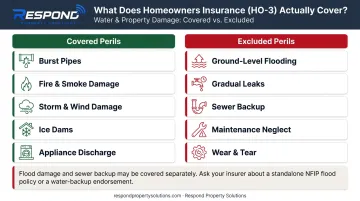
Standard HO-3 policies (the most common homeowners form) cover the dwelling for all perils except those explicitly excluded. Personal property is covered for named perils only — meaning only the specific causes of loss listed in the policy. Here's how specific damage types break down:
Water Damage
Covered scenarios include:
- Burst pipes and sudden pipe failures
- Accidental discharge from appliances (dishwashers, water heaters, washing machines)
- Storm-driven rain entering through roof damage
- Ice dam intrusion
The critical distinction: water must originate inside the structure. Ground-level flooding from rain, runoff, or snowmelt is excluded regardless of cause — that requires a separate flood insurance policy.
Fire and Smoke Damage
Fire and resulting smoke damage are covered under virtually all standard homeowners policies. Coverage typically extends to:
- Structural repair and rebuilding
- Soot cleanup and smoke residue removal
- Smoke odor remediation
- Contents restoration
No special sublimit applies to smoke remediation under standard HO-3 forms — coverage falls under overall dwelling and contents limits.
Mold Remediation
Mold coverage is conditional. It's covered when mold is a direct, documented result of a covered peril — for example, a burst pipe leads to mold growth within days. It's excluded when mold results from gradual moisture buildup, high humidity, or long-term neglect.
The EPA categorizes mold problems by size: small (under 10 sq ft), medium (10–100 sq ft), and large (over 100 sq ft). Larger remediation projects carry significant costs, which is why establishing the causal link to a covered peril — through professional documentation — is critical at claim time.
Storm and Wind Damage
Sudden storm events — a tree falls through a roof, wind drives rain into a structure — are covered. One important note for homeowners in Southern California and Arizona: wind and catastrophic event deductibles — triggered by Santa Ana wind events, desert windstorms, and declared disasters — can range from 1% to 15% of insured value, significantly higher than a standard flat deductible. If you're in a high-risk zone, review your policy's specific trigger language before a storm hits.
What Restoration Coverage Is Typically Excluded
Knowing what isn't covered prevents costly surprises after a loss.
Gradual Damage and Maintenance Neglect
This is the most common reason claims get denied. The ISO HO-3 policy form explicitly excludes:
- Wear and tear and deterioration
- Continuous or repeated seepage over weeks, months, or years
- Damage resulting from deferred maintenance
Insurers classify these as preventable maintenance failures — not sudden perils. A slow drip behind a cabinet wall that eventually causes wood rot will almost certainly be denied.
Flood Damage
Standard homeowners policies universally exclude ground-level flooding, regardless of cause. This includes:
- Storm surge
- Surface water runoff
- Debris flows following wildfires
- Rising groundwater
Coverage requires a separate flood insurance policy through the National Flood Insurance Program (NFIP) or a private carrier.
Sewer Backup and Sump Pump Failure
Like flood damage, sewer backup and sump pump failure are excluded from standard policies — but unlike flood, both can be added as an endorsement on your existing homeowners policy.
This distinction matters because sewage events involve Category 3 contaminated water, which carries serious health hazards and requires specialized remediation. Endorsement premiums are typically low relative to those remediation costs, and pricing varies by carrier and location. Contact your insurer to confirm what's available in your area.
The Restoration Insurance Claims Process: Step by Step
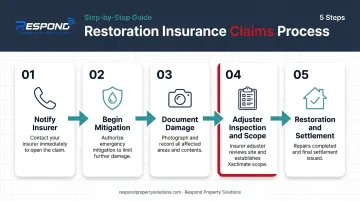
Step 1: Notify Your Insurer Promptly
Report the damage to your insurer as soon as possible. Delayed reporting can complicate coverage or reduce your payout — NAIC guidelines are clear on this. Emergency mitigation should begin at the same time as your notification, not after the adjuster visits.
Step 2: Begin Mitigation Immediately
Most policies include a duty to mitigate clause. You're required to take reasonable steps to stop damage from spreading. Leaving standing water for days, or failing to cover a damaged roof with tarping, can reduce or void your claim. It's a policy condition, not a suggestion.
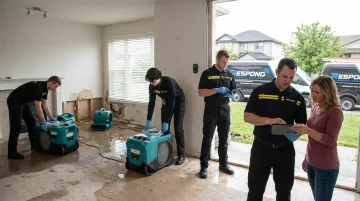
For homeowners in Southern California and Arizona, Respond Property Solutions' 24/7/365 dispatch model is built specifically around this requirement. Their crews reach the site within 2–4 hours and begin extraction, drying, or structural protection before secondary damage compounds.
Step 3: Document Before Any Cleanup
Before any materials are moved or discarded, capture:
- Photos and video of all affected areas from multiple angles
- The damage source (e.g., the burst pipe location)
- All damaged structural materials and contents
- Timestamps on all images
This documentation is the evidentiary foundation of your claim. Remove anything before photographing it and it's effectively gone from a claims perspective.
Step 4: The Adjuster Inspection and Scope of Work
The adjuster's job is to determine the cause of loss, apply coverage accordingly, and generate a scope of work. Xactimate is the industry-standard estimating software used by all major carriers. Restoration companies that submit Xactimate-compatible estimates reduce pricing disputes and accelerate approvals, which moves the claim forward faster for the homeowner.
Respond Property Solutions produces Xactimate-compatible documentation and photo evidence from the first day on-site, coordinating directly with regional insurance carriers so the claim moves forward without the homeowner acting as intermediary.
Step 5: Restoration and Final Settlement
Once the scope is agreed upon, the insurer pays for covered work minus your deductible. You have the right to choose your own licensed restoration contractor. Your insurer can suggest preferred vendors but cannot require their use. One contractor managing the full job, from mitigation through reconstruction, ensures documentation continuity and prevents scope gaps that can create claim disputes.
Documentation That Protects Your Claim Value
Adjusters make coverage decisions based on evidence — and gaps in that evidence are the leading reason claims come back underpaid or denied.
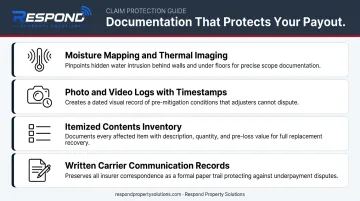
Moisture Mapping and Thermal Imaging Reports
Professional-grade moisture readings taken across multiple structural surfaces establish the true extent of water intrusion — not just what's visually apparent. This prevents adjusters from limiting scope to surface-level damage while concealed saturation continues to cause structural harm.
IICRC-certified crews conduct water damage work to ANSI/IICRC S500 standards, which include project documentation and inspection procedures as core components of the restoration process.
Photo and Video Logs With Timestamps
Capture damage from multiple angles before cleanup begins. Your documentation should include:
- The source of damage (burst pipe, water intrusion point)
- All affected structural materials
- Damaged contents with clear identification
- Timestamps on every image
Itemized Contents Inventory
Vague claims — "miscellaneous kitchen items damaged" — are routinely underpaid. Create a detailed inventory with:
- Item descriptions
- Estimated replacement values
- Purchase receipts or photos where available
Maintaining a home inventory before a loss occurs speeds this step and gives adjusters the itemized detail they need to process your claim accurately.
Written Records of Every Carrier Interaction
Keep a log of every communication with your insurer: claim numbers, adjuster names, dates, and the substance of each conversation. When a coverage dispute arises, the outcome frequently turns on what was said, by whom, and on what date.
What to Say — and What Not to Say — to Your Insurance Adjuster
Adjusters categorize damage as either covered (sudden and accidental) or excluded (gradual and preventable). How you describe events during an inspection can shift that classification.
What NOT to Say
Avoid any language that implies the damage was ongoing, previously known, or neglected:
- "This has been leaking for a while"
- "I've noticed this smell for months"
- "I kept meaning to fix it"
- "We knew there was a problem there"
These statements support a gradual damage classification — the most common grounds for denial. Stick to what you observed and when you first noticed it. What you say next matters just as much as what you avoid.
What TO Say and Do
- Describe factual observations: discovery date, what you saw, what you did immediately
- Request everything in writing from the adjuster
- Get the adjuster's name, direct contact information, and keep your own written record of the conversation
If the initial payout seems low:
- Request a re-inspection with your restoration contractor present
- Invoke the policy's appraisal clause for binding dispute resolution — check your policy documents to confirm this option is available
- Consult a licensed public adjuster — a professional who advocates solely for the policyholder in appraising and negotiating claims
How to Choose a Restoration Company That Works With Your Insurance
IICRC Certification
IICRC certification is the credential insurers and adjusters recognize as the industry standard for restoration competency. Certified firms produce the moisture mapping, thermal imaging, and documentation that meets adjuster documentation standards. Verify both company-level certification and that lead technicians carry credentials relevant to the work type (water, fire/smoke, or mold).
Xactimate Capability and Direct Adjuster Communication
Restoration companies that submit Xactimate-compatible estimates and communicate directly with adjusters dramatically reduce claim disputes compared to contractors who submit non-standard documentation. Ask any prospective contractor directly: "Do you submit Xactimate-compatible scopes, and will you communicate directly with my adjuster?"
Single Point of Accountability
Multiple handoffs between separate mitigation and rebuild companies create documentation gaps, scope inconsistencies, and claim complications. A single project manager who owns the job from emergency mitigation through final reconstruction ensures the documentation record stays continuous.
That's how Respond Property Solutions is structured. One project manager owns every job from the first call through the final walkthrough — no handoffs, no scope drift between phases, no ambiguity about who holds the documentation record. Respond is IICRC Certified and operates under the QRV Network quality standard, which the company established in 1991 and which regional insurers now reference in their own service agreements. Policyholders and adjusters deal with one person, start to finish.
Frequently Asked Questions
Is water damage restoration covered by insurance?
Water damage from sudden and accidental sources — burst pipes, appliance failures, storm-driven roof intrusion — is typically covered under standard HO-3 policies. Gradual leaks, ground-level flooding, and sewer backup are excluded or require separate coverage to be in place.
Does homeowners insurance cover mold restoration?
Mold remediation is covered only when the mold is a direct result of a covered peril, such as a burst pipe. Mold resulting from gradual moisture buildup, chronic high humidity, or deferred maintenance is typically excluded — regardless of how extensive the growth is.
What are my rights if my insurance denies a mold or water damage claim?
Request a written denial explanation from your insurer. From there, you can request a re-inspection with your restoration contractor present, invoke the policy's appraisal clause for binding dispute resolution, consult a licensed public adjuster, or file a complaint with your state insurance commissioner.
What should I not say to an insurance adjuster about water damage?
Avoid any language suggesting the damage was ongoing or previously known — phrases like "it's been leaking for weeks" or "we knew this was a problem" support a gradual damage classification that typically excludes coverage. Describe only what you observed and when you first noticed it.
Can I choose my own restoration contractor, or does my insurer decide?
You have the right to choose your own licensed restoration contractor. Your insurer can suggest preferred vendors, but the decision is yours. Verify your contractor is licensed and IICRC certified before work begins.
How does working with an IICRC-certified contractor affect my insurance claim?
IICRC-certified contractors produce moisture maps, thermal imaging reports, and photo-documented assessments that meet the evidentiary standards adjusters require. This documentation reduces scope disputes and supports fully funded claims by giving adjusters measurable, verifiable evidence of damage extent.