Introduction
Most commercial property owners invest seriously in fire suppression systems, security infrastructure, and structural safeguards — yet water quietly outpaces all of them as the leading cause of commercial property loss. According to Zurich North America, water damage accounts for 50% of all commercial real estate insurance claims. FM Global puts it even more starkly: liquid damage is more than twice as likely to damage a commercial building as fire.
Water's real threat to property value lies in how it operates. Unlike a fire or break-in, it starts invisibly — behind drywall, under flooring, inside HVAC systems. By the time visible signs appear, the structural and financial damage is already advanced.
What follows breaks down why water damage is uniquely destructive to commercial property value, where it typically starts, how to prevent it, and what to do when it strikes.
Key Takeaways
- Water damage accounts for 50% of commercial real estate insurance claims — the single leading cause of commercial property loss.
- Mold can begin colonizing porous materials within 24–48 hours of water exposure, making same-day response critical.
- Plumbing failures, HVAC leaks, and appliance issues together account for approximately 75% of commercial water losses.
- Every hour of delayed mitigation expands structural damage and drives up total restoration costs — professional response within the first 2–4 hours is the single biggest factor in limiting losses.
- Standard commercial policies rarely cover ground flooding or sewer backup; both require separate endorsements to avoid uncovered losses.
Why Water Damage Is the Silent Killer of Commercial Property Value
The Hidden Path Water Takes
Water doesn't travel in straight lines. It follows structural members, pipe chases, and subfloor cavities — surfacing far from its origin point. A slow drip inside a wall can migrate through building assemblies before announcing itself as a ceiling stain, by which time rot, mold, or material failure may already be advanced. Oak Ridge National Laboratory research confirms that water intrusion through wall systems is genuinely difficult to detect without specialized tools — moisture can be present and damaging long before it becomes visible.
This is why the term "silent killer" fits. There's no alarm, no obvious event. Just incremental damage compounding behind surfaces.
The Structural Cascade
Once moisture infiltrates a commercial building, it triggers a progressive failure sequence:
- Wood framing absorbs water, loses tensile strength, and begins to rot
- Drywall deteriorates and loses load capacity within days
- Concrete and masonry crack as freeze-thaw cycles or persistent saturation stress the material
- Metal components corrode, compromising connections and mechanical systems
- Subfloor systems warp, delaminate, or buckle
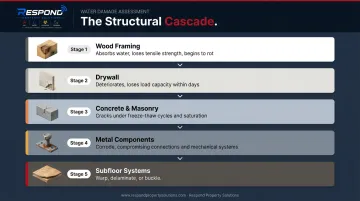
Each step accelerates the next. What starts as a minor leak becomes a structural remediation project if left unaddressed.
The Mold Clock
The EPA confirms that if wet materials are dried within 24–48 hours, mold will not grow. Cross that threshold, and mold spores begin colonizing porous materials — drywall, insulation, wood framing, ceiling tiles.
Mold creates two distinct problems for commercial property owners:
- Structural acceleration — mold degrades organic building materials faster than moisture alone
- Health and liability exposure — occupied commercial spaces with active mold colonies create tenant health risks and potential legal liability
Mold remediation under IICRC S520 protocols is significantly more involved than water-only mitigation — often adding weeks and five-figure costs to a project that could have been avoided. Response time is the deciding factor.
Electrical and Appraisal Consequences
Water infiltrating commercial electrical systems creates hazards that are almost entirely hidden behind walls. Common consequences include:
- Wire corrosion and junction box failure requiring panel replacement
- Rewiring of affected zones when water tracks along conduit runs
- Fire risk from short circuits in saturated wall assemblies
These repairs are among the most expensive secondary outcomes of a water event — and the least predictable.
The financial impact doesn't stop when the water does. Staining, residual odor, visible repair history, and disclosed water damage all affect appraiser assessments and tenant perception. Healthcare, hospitality, and industrial tenants conduct thorough due diligence before signing — and documented water intrusion histories raise red flags that can delay or kill lease negotiations.
The True Financial Cost — Beyond the Repair Bill
How Water Damage Suppresses Property Value
Commercial property value is primarily income-based: a cap rate applied to net operating income (NOI). Any disruption that reduces rent revenue or increases operating expenses directly suppresses asset value. Water damage does both simultaneously — repairs cost money and disrupt the income-generating capacity of the property while work is underway.
Chubb notes that commercial water damage losses can reach well into the millions when business interruption, lost rents, relocation costs, and reputational damage are factored in.
Business Interruption and Tenant Risk
A flooded retail suite, compromised office floor, or water-damaged healthcare facility may require full or partial closure for weeks. The direct repair cost is only part of the picture:
- Lost rental income during the closure period
- Tenant compensation claims for business disruption
- Lease termination clauses activated by tenants citing habitability or operational viability
- Relocation costs if tenants need to be housed temporarily
Insurance Cost Escalation
The financial impact extends into the next policy period. Risk & Insurance reports that separate water damage deductibles of $50,000 or $100,000 alongside a $25,000 all-other-peril deductible have become increasingly common in the commercial property market. A history of claims also signals risk to underwriters — NAIOP notes that insurers specifically assess water damage mitigation practices when determining policy terms.
Response Time as the Key Financial Variable
Those elevated deductibles and tighter policy terms make response speed a financial issue, not just an operational one. Every hour of unmitigated water exposure increases repair scope, mold probability, and secondary structural damage. How quickly mitigation begins is the most controllable cost driver in the entire loss. The IICRC S500 standard recognizes that mold colonization can begin within 24–48 hours — meaning a two-day delay doesn't just extend repairs, it introduces a separate remediation scope entirely.
Top Causes of Commercial Water Damage
Plumbing and Pipe Failures
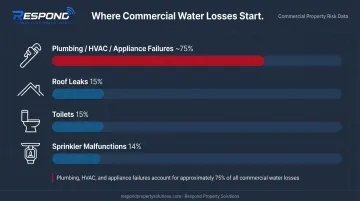
The Hartford reports that plumbing issues, HVAC leaks, and appliance failures account for approximately 75% of commercial water losses, making infrastructure the dominant risk category. Chubb identifies domestic plumbing as a primary culprit, citing corrosion, pipe bursts, and supply line failures as the leading drivers.
Toilets alone account for 15% of commercial water damage claims, according to Chubb, a figure especially significant in multi-story buildings with stacked plumbing configurations. In older commercial buildings across Riverside, Yuma, and El Centro, aging infrastructure compounds this risk.
Roofs, HVAC, and the Building Envelope
Roof leaks are responsible for an estimated 15% of commercial water damage claims and are the leading cause of ceiling water damage. Zurich North America confirms that toilets (15%), roofs (15%), and sprinklers (14%) together account for 44% of interior water damage in commercial buildings.
HVAC systems add another significant failure point, particularly in desert climates where units run under sustained extreme loads. Common culprits include:
- Condensate line clogs and improperly connected drain pans
- UV degradation that accelerates roofing membrane breakdown faster than national averages
- Arizona's monsoon season (June 15 – September 30, per NOAA), which delivers sudden high-volume water events that overwhelmed drainage systems may not handle
Sprinklers and Vacancy Risks
Sprinkler malfunctions (accidental activation, corroded heads, pressure failures) account for 14% of commercial water damage losses. Sprinkler systems can flood a suite in minutes, often before anyone on site responds.
Vacant commercial spaces carry outsized risk. A slow leak in an unoccupied suite can go undetected for days or weeks. FM Global notes that office buildings, hospitals, and hotels, which tend toward lighter occupancy, account for nearly nine out of ten liquid damage claims. When those spaces sit empty, detection delays turn minor leaks into major remediation projects.
Prevention Strategies That Protect Property Value
Water damage is almost always cheaper to prevent than to repair — and for commercial properties, prevention comes down to three operational habits: scheduled inspections, smart detection technology, and consistent envelope maintenance. Here's what each looks like in practice.
Structured Inspection Cadence
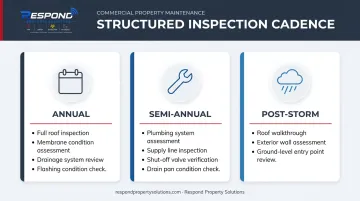
Establish a formal inspection schedule and stick to it:
- Annual: Full roof inspection, including membrane condition, drainage, and flashings
- Semi-annual: Plumbing assessment covering visible supply lines, shut-offs, and drain pans
- Post-storm: Immediate walkthrough of roof, exterior walls, and ground-level entry points
Pay particular attention to seldom-visited areas — vacant suites, storage rooms, and mechanical rooms. That's where slow leaks go undetected longest.
Leak Detection Technology
For most commercial properties, the ROI on detection hardware is straightforward: sensor systems cost far less than a single major loss event. FM Global recommends smart sensors and automatic shut-off valves as a direct risk-reduction measure. Key options worth deploying:
- Flow monitoring systems that flag anomalies suggesting active leaks or pipe failures
- Automatic shut-off valves that close supply lines when sensors detect moisture
- Zone sensors in mechanical rooms, server closets, and vacant suites — the highest-risk, lowest-visibility spaces
Chubb similarly includes water detection technology in its commercial mitigation recommendations. Some carriers offer more favorable policy terms for properties that deploy these systems — worth discussing with your broker before renewal.
Building Envelope Maintenance
Schedule these as recurring maintenance tasks, not reactive repairs:
- Roof membrane inspection and repair before monsoon season (Arizona) or storm season (SoCal)
- Re-caulking of window and façade penetrations annually
- Clearing of gutters and roof drains before high-rainfall periods
- Foundation waterproofing review in areas with seasonal ground saturation
In desert climates, UV exposure degrades sealants and roofing materials faster than in temperate regions — the maintenance cycle runs shorter here than national standards suggest.
What to Do When Water Damage Strikes
Immediate Action Framework
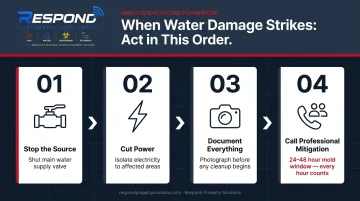
Act in this sequence:
- Stop the source — locate and shut the main water supply valve if accessible
- Cut power to affected areas if water has reached electrical systems
- Document everything with photos before moving any items or beginning cleanup
- Call a professional mitigation company immediately — the 24–48 hour mold window is real, and every hour counts
What Professional Mitigation Actually Involves
Professional commercial water mitigation is not surface-level cleanup. It includes:
- Industrial extraction equipment to remove standing water rapidly
- Commercial-grade air movers and dehumidifiers for structural drying
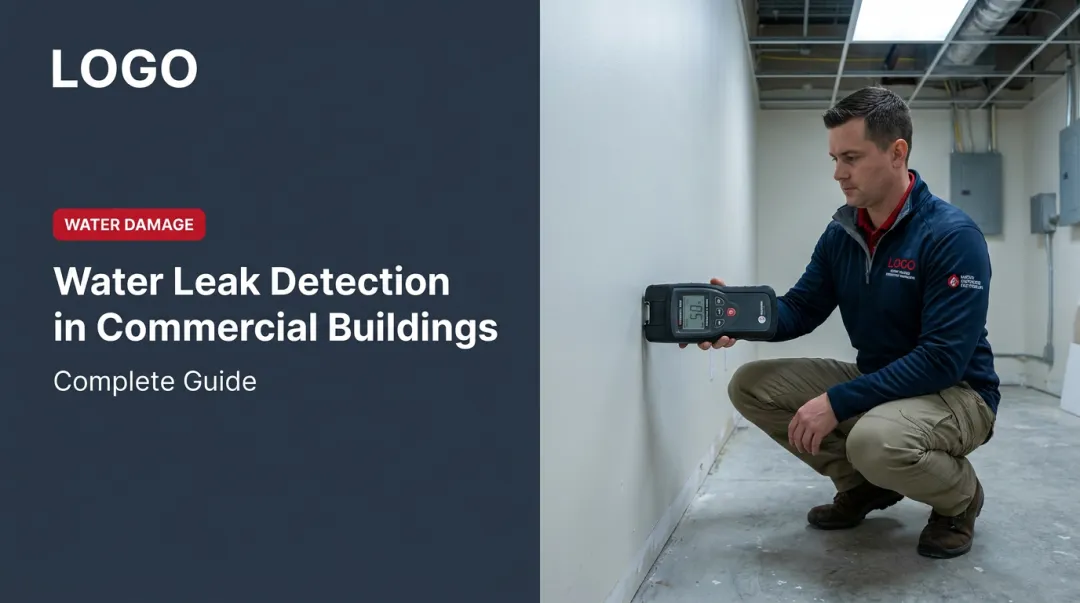
- Thermal imaging and moisture mapping to locate concealed moisture in walls, subfloors, and ceiling assemblies
- Containment protocols to prevent cross-contamination to occupied tenant spaces
What that equipment finds matters. Improper drying — leaving moisture in wall cavities or under flooring — creates concealed pockets that produce mold and structural damage surfacing months later. When that happens mid-claim, insurers push back on scope, and costs shift to the property owner.
Respond Property Solutions runs 24/7/365 operations across Southern California and Arizona, with a 45-minute live dispatch response and 2–4 hour on-site arrival. IICRC-certified crews work to IICRC S500 standards, and a single project manager owns every job from the first call to the final walkthrough. That means:
- No handoffs between teams
- No gaps in documentation continuity
- Direct adjuster communication built in from day one
Navigating Insurance After Commercial Water Damage
What's Covered — and What Isn't
Most commercial property insurance covers sudden and accidental water damage:
- Burst pipes and plumbing failures
- Sprinkler system malfunctions
- Appliance failures
- Storm-driven intrusion through a wind-damaged roof
Common exclusions include:
- Gradual damage from slow leaks (a standard policy gap)
- External flooding — requires a separate NFIP or private flood policy
- Sewer backup — typically requires a specific endorsement
- Equipment breakdown — often excluded without a rider
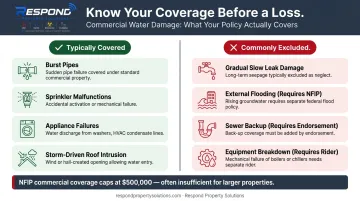
NFIP commercial coverage caps at $500,000 for the building and $500,000 for personal property — often insufficient for larger commercial properties. Many property owners discover these gaps only after a loss.
Documentation Is Non-Negotiable
Insurance adjusters assess claims based on documented evidence. Photo documentation, moisture meter readings, drying logs, scope of work, and repair estimates all need to be in place from the first hour — not assembled retroactively.
Respond Property Solutions produces Xactimate-compatible scopes with photo documentation and communicates directly with adjusters throughout the claim. For property managers navigating a large-loss commercial claim, the claim file is built by the same project manager running the job — eliminating the documentation gaps that most commonly result in underpayment.
Post-Incident Coverage Review
After any water damage event, review your policy with your broker to assess:
- Whether sewer backup coverage is in place
- Whether equipment breakdown and business interruption limits reflect actual exposure
- Whether flood coverage through NFIP or a private carrier is adequate for your location
These gaps rarely surface until a claim is already in progress. Deferred coverage adjustments compound risk — the second event almost always arrives before the fix does.
Frequently Asked Questions
Is water damage covered by commercial property insurance?
Coverage typically applies to sudden and accidental events — burst pipes, sprinkler failures, and storm-driven intrusion. Most policies exclude gradual damage from slow leaks, external flooding, and sewer backup unless you add specific endorsements. Review your policy before a loss occurs, not after.
How much will commercial property insurance pay for water damage?
The payout depends on your policy limits, deductibles, and documented scope of damage. Commercial losses can reach into the millions once business interruption and lost rents are factored in — and gaps in documentation are the most common reason claims fall short.
Can a landlord sue you for water damage?
Yes. A landlord can pursue a tenant for water damage caused by tenant negligence or lease violations. The outcome hinges on what the lease says about maintenance responsibilities and whether the tenant's commercial liability coverage responds.
What are the most common causes of commercial water damage?
The leading sources are plumbing failures, roof leaks, HVAC condensate overflow, and sprinkler malfunctions. Routine inspections catch most of these before they become a claim.
How quickly does water damage become a serious problem in a commercial building?
Structural materials begin absorbing moisture immediately. Mold can start colonizing within 24–48 hours of water exposure. Every hour of delay adds to both repair costs and mold risk — same-day response is the standard that limits both.
What should I do immediately after discovering water damage in my commercial property?
Stop the source if accessible, document with photos before touching anything, and call a professional mitigation company with 24/7 availability. Delaying response by even a few hours directly increases both repair costs and mold risk.