Behind those numbers is real business disruption: lost revenue during closure, equipment replacement, employee displacement, and OSHA compliance exposure carrying penalties up to $165,514 for willful violations. For small businesses especially, recovery is never guaranteed — the SBA reports that 25% of businesses don't reopen after a major disaster.
The good news: most commercial fire risks are controllable. This guide gives business owners and property managers a practical framework for preventing fires, maintaining detection and suppression systems, and preparing their teams — before an emergency makes those decisions for you.
Key Takeaways
- Electrical failures and overloaded circuits are among the leading causes of commercial fires — routine inspection is non-negotiable.
- Detection and suppression systems only work when properly maintained — installation alone isn't enough.
- OSHA requires a written evacuation plan for businesses with more than 10 employees — and it must be practiced.
- Fire extinguishers require monthly visual checks and annual professional inspection under OSHA 29 CFR 1910.157.
- After a fire, the speed of professional restoration in the first 24–48 hours directly determines how much of your business survives.
Core Fire Prevention Measures for Your Business
Every fire needs three things: heat, fuel, and oxygen. Most prevention measures target at least one of these. The good news is that the most effective controls — electrical management, housekeeping discipline, and equipment protocols — don't require significant investment.
Electrical Hazard Management
Electrical failures are a persistent commercial fire risk. NFPA data on non-home electrical fires shows an estimated annual average of 16,930 structure fires involving electrical failures in non-home properties. USFA data for 2023 puts electrical malfunction at 7,400 nonresidential building fires that year alone.
Practical controls your business should implement:
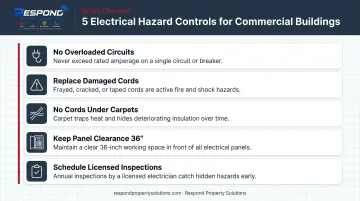
- Never overload circuits, surge protectors, or power strips
- Replace damaged or frayed cords immediately — don't tape them
- Avoid running extension cords under carpets, rugs, or across doorways
- Keep electrical panels clear and accessible with at least 36 inches of clearance
- Schedule periodic inspections with a licensed electrician, especially in older buildings or after any renovation work
Flickering lights, repeatedly tripped breakers, or outlets that feel warm to the touch are not minor annoyances. They're early warning signs that warrant immediate attention.
Housekeeping and Clutter Control
Clutter is fuel. Excess paper, cardboard, overfull bins, and disorganized storage don't just look bad — they accelerate fire spread and can turn a contained ignition into a total loss within minutes.
Fire code requirements are clear: emergency exits and aisles must remain unobstructed at all times. The housekeeping controls below address both the legal requirement and the practical risk behind it.
Key housekeeping controls:
- Establish a regular schedule for removing combustible waste, particularly near electrical equipment
- Store flammable materials — paints, solvents, cleaning chemicals — in clearly labeled, well-ventilated areas away from heat sources
- Never stack materials in storage areas without accounting for sprinkler clearance (more on that below)
- Designate a responsible person per floor or zone for ongoing compliance checks
Heat-Producing Equipment and Appliances
Copiers, servers, coffee makers, microwaves, industrial machinery — all generate heat and all need deliberate placement and end-of-day protocols.
Specific actions to take:
- Position heat-producing equipment away from paper, fabric, and other combustibles
- Power down or unplug non-essential equipment at the end of each workday
- Server rooms require dedicated cooling systems and should never be used as secondary storage
- Replace incandescent lighting with LED alternatives, which run significantly cooler and reduce ignition risk near fixtures
Many commercial equipment fires start after hours — when a device left running overnight overheats with no one present to respond. End-of-day shutdown checklists are one of the simplest controls a business can put in place.
Fire Detection and Suppression Systems
Once a fire starts, detection and suppression systems have seconds to minutes to contain it. How well they perform that job depends almost entirely on maintenance — not on installation alone.
Smoke Alarms and Commercial Detectors
Commercial fire alarm systems are governed by NFPA 72 (current edition: 2025). Unlike residential smoke alarms, commercial detectors don't follow a blanket 10-year replacement rule. Per NFPA's guidance on commercial detector maintenance, they require scheduled inspection, sensitivity testing, and maintenance per NFPA 72 and manufacturer specifications.
Practical steps for your facility:
- Work with your fire alarm service contractor to establish an inspection and sensitivity testing schedule
- Pay particular attention to low-traffic areas — storage rooms, basements, back offices — where a slow-developing fire can burn longest before being detected
- Don't assume a detector is functional just because no alarm has triggered; sensitivity drift is a real failure mode
Fire Sprinkler Systems
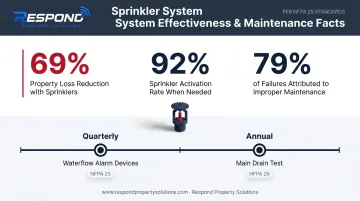
Automatic sprinklers are the most effective fire suppression tool available to commercial buildings. NFPA's sprinkler effectiveness research shows sprinklers reduced average property loss by 69% in stores and offices. When a fire was large enough to activate the system, sprinklers operated in 92% of cases and were effective 97% of the time.
Critical maintenance requirements:
- Keep all sprinkler heads completely unobstructed — OSHA 29 CFR 1910.159(c)(10) requires a minimum 18-inch vertical clearance between sprinkler heads and stored materials
- Schedule inspections per NFPA 25 standards (waterflow alarm devices require quarterly inspection and annual testing at minimum)
- 79% of sprinkler failures result from systems being shut off, damaged, or improperly maintained — not from equipment defects
Fire Extinguishers
Under OSHA 29 CFR 1910.157, extinguishers must be mounted, visible, and accessible without putting employees at risk. Monthly visual inspections and annual maintenance checks are required, with records retained.
Extinguisher class selection matters:
| Class | Use For |
|---|---|
| Class A | Ordinary combustibles (paper, wood, fabric) |
| Class B | Flammable liquids |
| Class C | Energized electrical equipment |
| Class K | Cooking media (kitchens) |
Every employee should know where extinguishers are located and understand the PASS technique: Pull, Aim, Squeeze, Sweep. Confirm that knowledge through periodic walkthroughs — not just a training document employees signed once.
Emergency Preparedness and Evacuation Planning
OSHA 29 CFR 1910.38 requires a written Emergency Action Plan for businesses with more than 10 employees. The plan must be kept on-site and available for employee review.
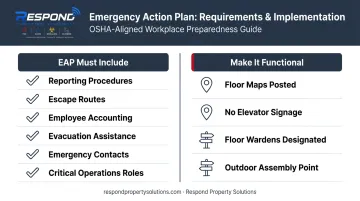
A complete EAP covers both the chain of command and the step-by-step actions every employee must take when an alarm sounds. At minimum, it must address:
What a complete EAP must include:
- Procedures for reporting a fire or emergency
- Designated escape routes and exit assignments
- Procedures for accounting for all employees after evacuation
- Provisions for employees who may need assistance evacuating
- Names or job titles of employees to contact for more information
- Procedures for employees who must remain to manage critical operations before evacuating
Having the requirements on paper is only the start. The physical environment must support the plan:
Making the plan functional:
- Post "you are here" floor maps with exit routes on every floor
- Include signage that prohibits elevator use during emergencies
- Designate floor wardens to check each area for occupants before exiting
- Establish a clear outdoor assembly point for headcount
A written plan only works if people know it. Run drills at least twice a year, walk new hires through it during onboarding, and update the document whenever the facility layout, staffing, or emergency contacts change.
Common Fire Prevention Mistakes Businesses Make
Most preventable commercial fires have one thing in common: the hazard was visible, the risk was known, and nothing was done about it.
The most frequent mistakes and their consequences:
- Skipping monthly smoke alarm and detector checks — "the battery still seems fine" is not an inspection
- Ignoring electrical warning signs — flickering lights and tripped breakers that recur are symptoms, not nuisances
- Leaving heat-producing equipment running overnight — what ran safely all day can become a hazard overnight
- Assuming an installed extinguisher is still compliant — if it hasn't been professionally inspected within the last 12 months, it may not be
- Treating "no fire so far" as evidence that current practices are safe — complacency is the most common contributor to preventable losses
Flammable material mismanagement is a separate category worth calling out. Storing flammable substances near heat sources or in unventilated spaces, skipping manufacturer safety data sheet review, and using standard tools in areas where static electricity could ignite vapors are all documented causes of avoidable fires.
If your business uses or stores combustible liquids, review NFPA 30. It sets the governing standard for flammable and combustible liquid storage and is the reference point for most code inspections.
When Prevention Isn't Enough: Fire Damage Response
Even well-prepared businesses experience fires. When it happens, what you do in the first hours determines how much of your operation can be recovered.
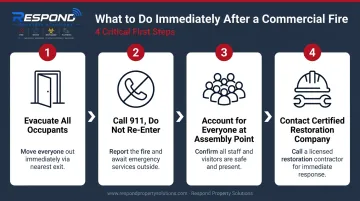
Immediate steps after a commercial fire:
- Evacuate all occupants using pre-designated routes
- Call 911 — do not re-enter the structure for any reason
- Meet at your assembly point and account for everyone
- Once the structure is cleared by fire officials, contact a certified fire damage restoration company immediately
Fire damage extends far beyond what flames touched. Smoke, soot, and toxic residue travel through HVAC systems and penetrate materials throughout a building. Areas that look unaffected may still require professional assessment and mitigation.
For commercial properties in Southern California and Arizona, Respond Property Solutions offers IICRC-certified fire and smoke damage restoration available 24/7/365. They respond to commercial losses with a live answer within 45 minutes, crews on-site within 2–4 hours, and a single project manager coordinating soot removal, smoke odor elimination, contents cleaning, structural rebuild, and direct insurer communication through the final walkthrough.
Five branch locations across San Diego, Imperial, Riverside, San Bernardino, Orange, La Paz, and Yuma counties keep local crews within reach. Call 866.867.3123.
Frequently Asked Questions
What does fire damage restoration involve?
Fire damage restoration covers smoke and soot removal, structural cleaning and deodorization, contents salvage, and reconstruction. IICRC-certified professionals assess all affected areas (including spaces damaged by smoke traveling through HVAC systems), not just areas reached by flames.
What are the most common causes of commercial building fires?
Cooking equipment leads all causes at 33,300 fires per year (USFA 2023), followed by intentional fires, electrical malfunction (7,400 fires), and heating equipment. Electrical failures are especially dangerous because they often ignite inside walls before anyone notices.
How often should businesses test their fire suppression systems?
Each system follows its own schedule: smoke alarms per NFPA 72 (coordinate with your service contractor), fire extinguishers monthly visually and annually by a professional per OSHA, and sprinklers per NFPA 25 — quarterly for waterflow devices and annually for main drain tests.
What should employees do if they discover a fire at work?
Activate the nearest fire alarm pull station, call 911, and evacuate using the nearest safe route. Use an extinguisher only if the fire is small and an exit is directly behind you. Meet at the designated assembly point for a headcount — do not re-enter the building.
Does business insurance typically cover fire damage?
Most commercial property policies include fire coverage, but limits vary. Business interruption, code-upgrade costs, and certain contents may not be fully covered. Review your policy annually and ask your broker about supplemental options like ordinance and law coverage.
How do I create a fire evacuation plan for my business?
Map all exits on a floor plan, assign roles (floor wardens, headcount officers), establish an outdoor assembly point, and post the plan visibly on each floor. Practice the plan at least twice a year with all staff, including new hires, and update it whenever your layout, team, or emergency contacts change.