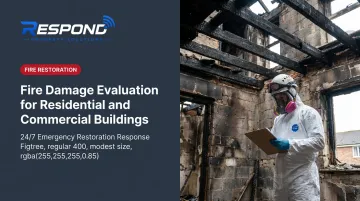
Done properly, this assessment is the diagnostic foundation for everything that follows. Done poorly — or skipped — it creates cascading problems: missed structural hazards, disputed insurance claims, and secondary damage that compounds daily.
This article covers what a professional fire damage evaluation actually includes, how the process works step by step, and why the differences between residential and commercial protocols matter for both recovery time and claim outcomes.
Key Takeaways
- Fire damage evaluation is a structured inspection conducted before any restoration work begins — it determines scope, cost, and safety classification
- Four damage categories drive every assessment: structural, smoke and soot, suppression water, and hazardous materials
- Evaluation outcomes place properties into one of three response tiers — each tier directly shapes what your insurance claim covers and how quickly work can begin
- Residential and commercial evaluations follow different protocols with different regulatory requirements
- Secondary damage from moisture and soot migration accelerates within 24–72 hours — delay compounds the loss
What Is Fire Damage Evaluation and Why Does It Matter?
Fire damage evaluation is a systematic, certified inspection of a property that classifies the type, extent, and severity of damage caused by combustion, heat, smoke, soot, and suppression water. It's governed by frameworks such as the ANSI/IICRC S700 Standard for Professional Fire and Smoke Damage Restoration, which establishes how fire residue, heat intensity, and damage boundaries are assessed across structures, HVAC systems, and contents. The result is a documented scope that drives every decision that follows — what gets cleaned, what gets replaced, and what gets submitted to the insurer.
Why Speed Matters
According to the EPA's mold guidance, water-damaged materials should be dried within 24–48 hours to prevent mold colonization — a clock that starts the moment firefighting water enters the structure. Smoke and soot continue migrating through HVAC systems and porous materials in the hours following a fire, expanding the affected area and the remediation scope.
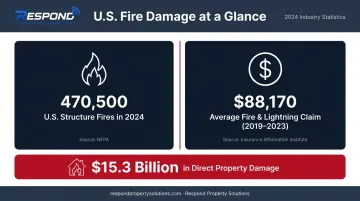
The financial stakes reinforce that urgency. NFPA data shows 470,500 U.S. structure fires in 2024, causing $15.3 billion in direct property damage. The Insurance Information Institute reports a weighted average fire and lightning claim severity of $88,170 for 2019–2023. Documentation quality directly affects how much of that loss gets covered.
Who Depends on the Evaluation
Three groups rely on the assessment results:
- Property owners — to understand what they're actually facing, not just what's visible
- Insurance adjusters — to validate claims, set reserves, and approve scope
- Restoration contractors — to scope work accurately and price remediation without gaps
What Does a Professional Fire Damage Assessment Include?
A complete evaluation addresses four distinct damage categories, each requiring different methods and informing different parts of the restoration scope.
Structural Damage Inspection
Evaluators examine wooden framing for char depth and section loss, test masonry for calcination (a hollow sound when struck indicates significant compromise), and check steel members for warping, buckling, or twisting. Visible deformation is evidence that high-temperature exposure may have altered the metal's structural properties.
When char depth, residual section capacity, or connection integrity raises questions, the assessment warrants a structural engineering referral. U.S. Forest Service research supports evaluating char depth alongside residual section and engineering judgment rather than a single universal threshold.
Smoke and Soot Mapping
Inspectors classify residue type across affected zones. Dry smoke from high-temperature combustion leaves powdery deposits; wet smoke from slow, smoldering fires leaves sticky, more penetrating residue. The residue type determines the cleaning method because what works for one can spread or permanently set the other.
Soot also migrates through HVAC systems into rooms well beyond the fire's origin. Per NADCA ACR 2021 standards, HVAC components subjected to heat and smoke require evaluation for restoration, and replacement is required when they cannot withstand cleaning or continue to retain odor. Ductwork, coils, and filters are a separate line item in any complete assessment.
Suppression Water and Moisture Assessment
Firefighting water can affect large portions of the unburned structure including areas with no visible fire damage but significant moisture intrusion. Evaluators use:
- Thermal imaging cameras to screen for hidden moisture in walls and subfloors
- Pin-type moisture meters to confirm readings at specific locations
- Air quality monitors to identify airborne particulate concentrations
The 24–48 hour mold risk window makes moisture mapping time-sensitive.
Hazardous Material Identification
Fire disturbs materials that don't require remediation under normal conditions. Two categories demand attention before any work begins:
- Asbestos (ACM/PACM): Under OSHA 29 CFR 1926.1101, materials with more than 1% asbestos and presumed ACM in structures built no later than 1980 require screening before disturbance. EPA NESHAP rules also mandate a thorough asbestos inspection before any demolition or renovation.
- Combustion byproducts: Polycyclic aromatic hydrocarbons (PAHs), documented in NIOSH's 2019 Carr Fire debris cleanup sampling, may require industrial hygiene sampling where ash and soot contamination creates worker or occupant exposure risk.
Documentation and Scope Report
The assessment report consolidates all findings into a single deliverable:
- Photographic evidence and damage classification maps
- Material inventories and residue zone boundaries
- Moisture intrusion mapping
- Hazmat screening results
- Recommended scope of work
Xactimate-compatible formatting means the contractor's scope maps directly to the format adjusters use to evaluate and price losses — no translation required, no delays waiting for reformatted documentation.
How Fire Damage Evaluation Works: Step by Step
Property owners commonly enter a fire-damaged structure or begin cleanup before professional evaluation is complete. This can compromise structural safety, destroy documentation, and derail insurance claims. Each step below exists for a reason — skip one, and the scope report, adjuster coordination, and contractor estimates all suffer for it.
Step 1 — Safety Clearance and Site Entry
No evaluation begins until the structure is cleared for entry by the authority having jurisdiction (AHJ) — typically the municipal fire marshal or building department. Utilities must be confirmed as isolated before any interior access. Both occupants and restoration crews depend on that clearance before anyone steps inside.
Step 2 — Exterior and Perimeter Evaluation
Evaluators photograph and document all exterior damage: roof penetrations, wall collapse zones, exposed utility connections, and open window and door areas. This establishes the fire origin quadrant and sequences the interior survey.
Step 3 — Interior Structural Survey
Certified inspectors conduct a room-by-room structural survey, probing char depth on wooden members, testing masonry integrity, and identifying steel components showing heat distortion. The goal is determining which load-bearing elements — beams, roof assemblies, floor systems, wall framing — have been compromised by direct flame, heat exposure, or prolonged burn time.
Step 4 — Smoke, Soot, and Odor Zone Mapping
Evaluators move zone by zone identifying:
- Residue type (dry vs. wet smoke characteristics)
- Surface penetration depth
- Migration pathways through HVAC and structural cavities
This step determines which rooms require full contents removal, which need surface cleaning, and which need deep deodorization — decisions that directly affect total restoration cost.
Step 5 — Moisture and Air Quality Measurement
Thermal imaging screens for suppression water that has migrated into walls, subfloor systems, and insulation — areas invisible to the naked eye. Meter readings confirm and quantify what imaging identifies. Air quality measurements capture airborne particulate concentrations that may pose ongoing health risks for occupants or workers.
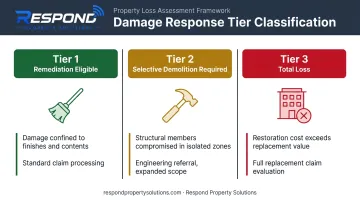
Step 6 — Scope Report and Damage Tier Classification
The evaluator compiles findings into a scope report and classifies the property into one of three response tiers:
| Tier | Condition | Insurance Implication |
|---|---|---|
| 1 — Remediation eligible | Damage confined to finishes and contents | Standard claim processing |
| 2 — Selective demolition required | Structural members compromised in isolated zones | Engineering referral, expanded scope |
| 3 — Total loss | Restoration cost exceeds replacement cost or structural value threshold | Full replacement claim evaluation |
This classification directly drives insurance claim processing and contractor scope development.
Residential vs. Commercial Fire Damage Evaluation: Key Differences
Residential Evaluations
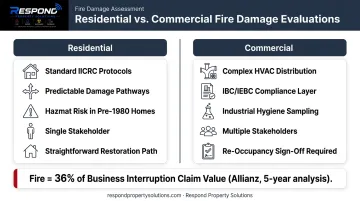
Residential assessments are typically led by IICRC-certified restoration contractors following standard protocols. Common fire patterns — kitchen fires, electrical fires in wall cavities — follow predictable damage pathways.
One significant variable: pre-1980 homes carry additional hazmat risk. Asbestos insulation, lead paint on painted surfaces, and other materials common in older construction require specialized testing before any demolition or invasive work begins, regardless of how contained the fire appears.
Commercial Evaluations
Commercial assessments are structurally more complex across several dimensions:
- Larger structures with more extensive HVAC distribution, meaning soot and smoke migrate farther and affect more zones
- Compliance requirements — commercial building codes (IBC) and repair provisions (IEBC) add a regulatory layer separate from the insurance claim
- Industrial hygiene — airborne contaminant sampling for PAHs, silica, and other hazards may be required, particularly in manufacturing, healthcare, or school settings
- Multiple stakeholders — property managers, tenants, multiple insurance carriers, and business interruption calculations all factor into the scope
- Re-occupancy sign-off — the evaluation report must satisfy building department review before employees or tenants can return, a compliance step that rarely applies to residential claims
For commercial properties — hotels, healthcare facilities, multi-family complexes, schools — minimizing downtime is a primary driver. According to Allianz's analysis of over 1,000 BI claims exceeding $1.3 billion across the five years ending 2023, fire was the most frequent business interruption cause, representing 36% of total claim value.
Precise scope documentation directly affects recovery timelines, claim settlements, and re-occupancy approvals. In commercial settings, getting it right the first time isn't optional.
How Respond Property Solutions Supports Fire Damage Evaluation
Respond Property Solutions serves residential, commercial, and large-loss properties across Southern California and Arizona as an evaluation-through-restoration partner. IICRC-certified crews typically arrive on-site within 2–4 hours of the initial call, with a live answer within 45 minutes — no third-party call centers, no transfer queues.
One project manager is assigned from the first call through the final walkthrough, covering scope development, adjuster coordination, sub-trade scheduling, and the final inspection. For property owners, this means one consistent contact across every phase. For insurance adjusters, it means documentation that doesn't change hands.
Respond's evaluation process produces Xactimate-compatible scopes with photo documentation and direct adjuster communication from the start — not after the fact. The report is built to support the insurance claim from minute one, reducing delays and documentation disputes for both residential and commercial clients.
Five branch locations provide 24/7/365 dispatch across the region, ensuring mitigation begins inside the policy window:
- El Centro & Yuma — Imperial, La Paz, and Yuma counties
- Redlands & Riverside — San Bernardino, Riverside, and Orange counties
- Palm Springs — Riverside County desert corridor
- All branches — San Diego County coverage via coordinated dispatch
Conclusion
Fire damage evaluation is not a preliminary formality — it is the diagnostic foundation that determines whether a property can be safely restored, how long recovery will take, and what the insurance claim should actually cover.
The evaluation report should be reviewed carefully by the property owner and shared with the insurer before any cleanup or demolition begins. Starting restoration without it doesn't save time — it risks compromising the claim, missing hazards, and expanding the scope unnecessarily.
Respond Property Solutions handles evaluation and restoration under one IICRC-certified project manager — so nothing falls through the gap between assessment and recovery. If you've experienced fire damage in Southern California or Arizona, call 866.867.3123 for a 24/7 response.
Frequently Asked Questions
What does a fire damage assessment include?
A complete assessment covers four components: structural inspection, smoke and soot mapping, suppression water and moisture measurement, and hazardous material identification. All findings are compiled into a written scope report used for insurance documentation and contractor scoping.
How long does a fire damage evaluation take?
Evaluation time depends on property size and damage severity. A single-room residential fire may take a few hours; a large commercial property or total-loss scenario can require multiple days. The written scope report typically requires additional time to compile after the physical inspection.
Who performs a fire damage evaluation — a restoration contractor or a structural engineer?
IICRC-certified restoration contractors lead the standard evaluation. Structural engineers are brought in when load-bearing elements show significant char depth or heat compromise affecting structural capacity. Hazmat professionals join the team when asbestos or other regulated materials are present.
How does a fire damage evaluation affect my insurance claim?
The written scope report is the primary documentation supporting an insurance claim, detailing damage categories, material inventories, and the recommended scope of work. Xactimate-compatible reports align directly with how adjusters assess and price losses, reducing disputes and speeding claim processing.
What is the difference between a residential and commercial fire damage evaluation?
Commercial evaluations involve larger structures, more complex HVAC distribution, regulatory re-occupancy requirements, and multiple stakeholders such as tenants, property managers, and separate insurers. Residential evaluations follow standard protocols, though pre-1980 construction materials often trigger additional hazmat testing requirements.